
By Bhavya Web Technologies
For years, businesses chased the same goal online:
Look modern.
Look premium.
Look polished.
And for a while, that worked.
Then AI arrived.
Today, great-looking websites can be created faster than ever. Layout generators, AI copywriting tools, stock imagery, templates, and automated design systems have dramatically lowered the barrier to producing “good” digital experiences. But there’s a side effect nobody talks about enough:
Everything is starting to look the same.
And that may become one of the biggest branding problems of 2026.
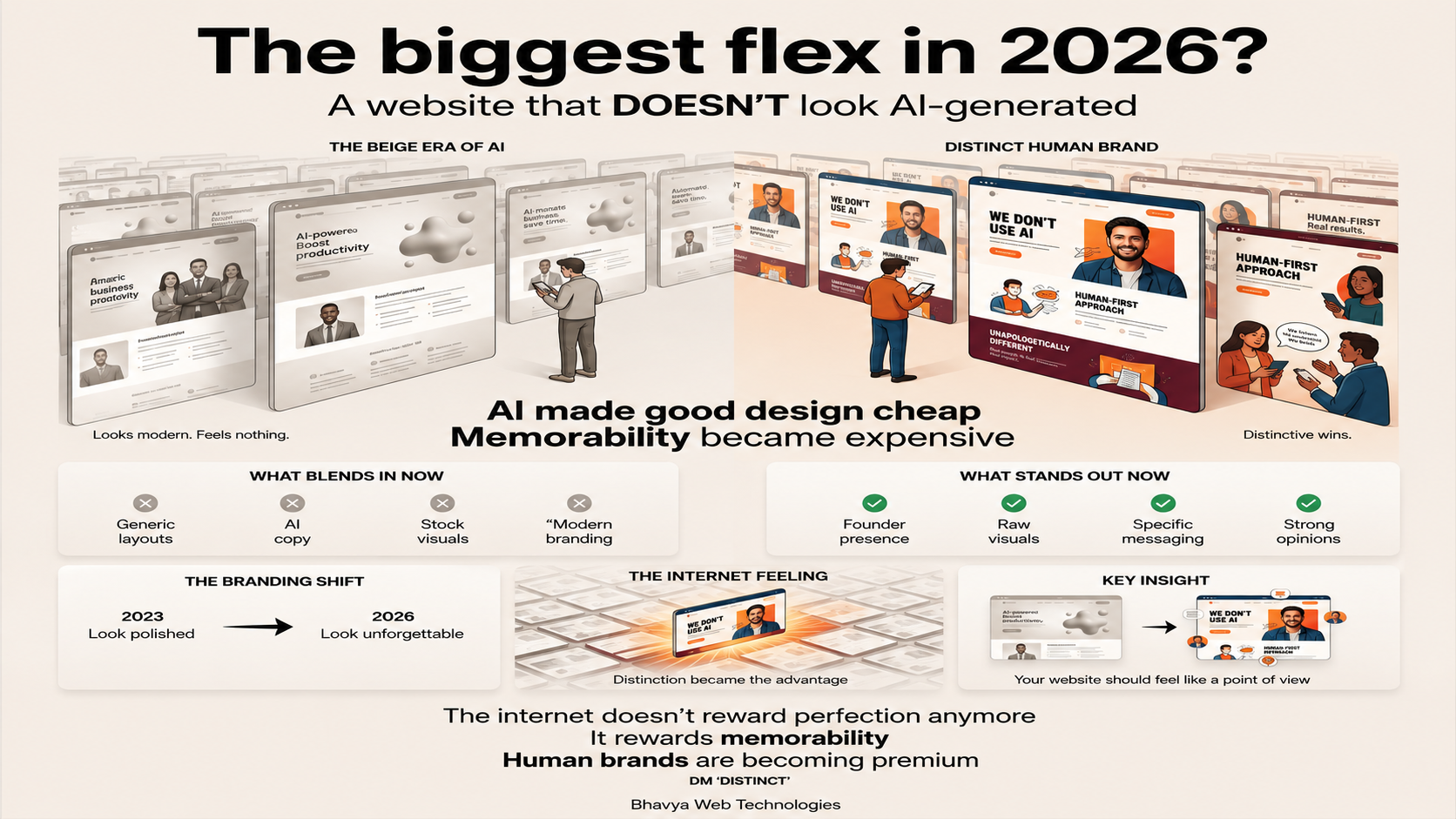
Welcome to the Beige Era of AI
Open ten websites in the same industry.
You’ll probably see:
Similar hero sections
Similar gradients
Similar headline structures
Similar AI-generated messaging
Similar stock-inspired visuals
Similar “clean modern” aesthetics
Nothing looks bad.
But very little feels memorable.
There’s growing discussion across branding and creative circles that as AI makes content production easier, differentiation becomes harder—and taste, identity, and originality become more valuable.
That creates a new reality:
Good design is becoming accessible. Distinction is becoming expensive.
The New Problem Isn’t Quality. It’s Sameness.
For years, businesses competed on execution.
Now execution is abundant.
Templates are polished.
Fonts are optimized.
Layouts convert.
So users stopped rewarding polish alone.
Instead, they started rewarding recognition.
When someone visits your website, the question is no longer:
“Does this look professional?”
The question is:
“Will I remember this tomorrow?”
That shift changes everything.
Why Human Brands Are Winning Attention
The brands getting attention today are often not the ones with the most polished visuals.
They are the ones with the clearest identity.
They communicate like people—not committees.
They show who they are.
That often means:
1. Founder Presence
People trust people.
Showing leadership, ideas, stories, and visible expertise creates emotional connection that generic corporate messaging rarely achieves.
Visitors increasingly want to know:
Who built this?
What do they believe?
Why should I trust them?
Authenticity and human connection are becoming stronger brand signals in an AI-heavy environment.
2. Raw Visual Storytelling
Not messy.
Not low quality.
Human.
Real office moments.
Actual team images.
Original product visuals.
Behind-the-scenes content.
Creative trends increasingly point toward texture, warmth, imperfection, and emotionally resonant design instead of hyper-polished synthetic aesthetics.
3. Specific Messaging
Generic copy disappears.
Specific messaging creates memory.
Compare these:
❌ “We help businesses grow.”
vs.
✅ “We redesign outdated service websites into lead-generating brands in 30 days.”
Specificity wins because it creates immediate positioning.
4. Strong Opinions
The safest brands are often invisible.
Brands that stand out usually make choices.
- what they believe
- who they serve
- what they reject
- how they work differently
That doesn’t mean being controversial.
It means being clear.
AI Didn’t Kill Branding. It Raised the Standard
AI is not the enemy.
AI is one of the best production tools ever created.
Use AI for:
- faster workflows
- content support
- research
- testing ideas
- scaling operations
But don’t outsource identity.
Because AI can generate output.
It cannot replace lived experience, conviction, taste, or perspective.
Research and industry analysis increasingly point toward hybrid branding models where AI drives efficiency while human creativity creates emotional connection and trust.
The Branding Shift: 2023 → 2026
Old internet:
Look polished → earn trust
New internet:
Look memorable → earn attention
Old websites:
Information-first
New websites:
Perspective-first
Old differentiation:
Better execution
New differentiation:
Better identity
This doesn’t mean abandoning usability or modern design.
It means adding something templates cannot replicate.
Your Website Should Feel Like a Point of View
Ask yourself:
- Does my website sound like my company?
- Could my homepage belong to any competitor?
- Are my visuals recognizable?
- Does someone remember us after leaving?
- Does our brand feel human?
If the answer is no, the problem probably isn’t design quality.
It’s distinction.
Because the biggest flex in 2026 may not be having the most advanced website.
It may simply be having one people remember.
Conclusion
The internet doesn’t reward perfection the way it used to.
It rewards identity.
AI made professional websites easier.
Human brands made memorable websites valuable.
Your website should not feel like a template.
It should feel like a point of view.
Ready to build a website that stands out instead of blending in?
Bhavya Web Technologies — Kukatpally, Hyderabad