
Discounts work.
A 20% reduction can encourage a hesitant customer to buy. A seasonal sale can clear inventory. A limited-time promotion can generate urgency and bring attention to a product.
The problem begins when the discount stops being a tactic and becomes the entire reason customers purchase.
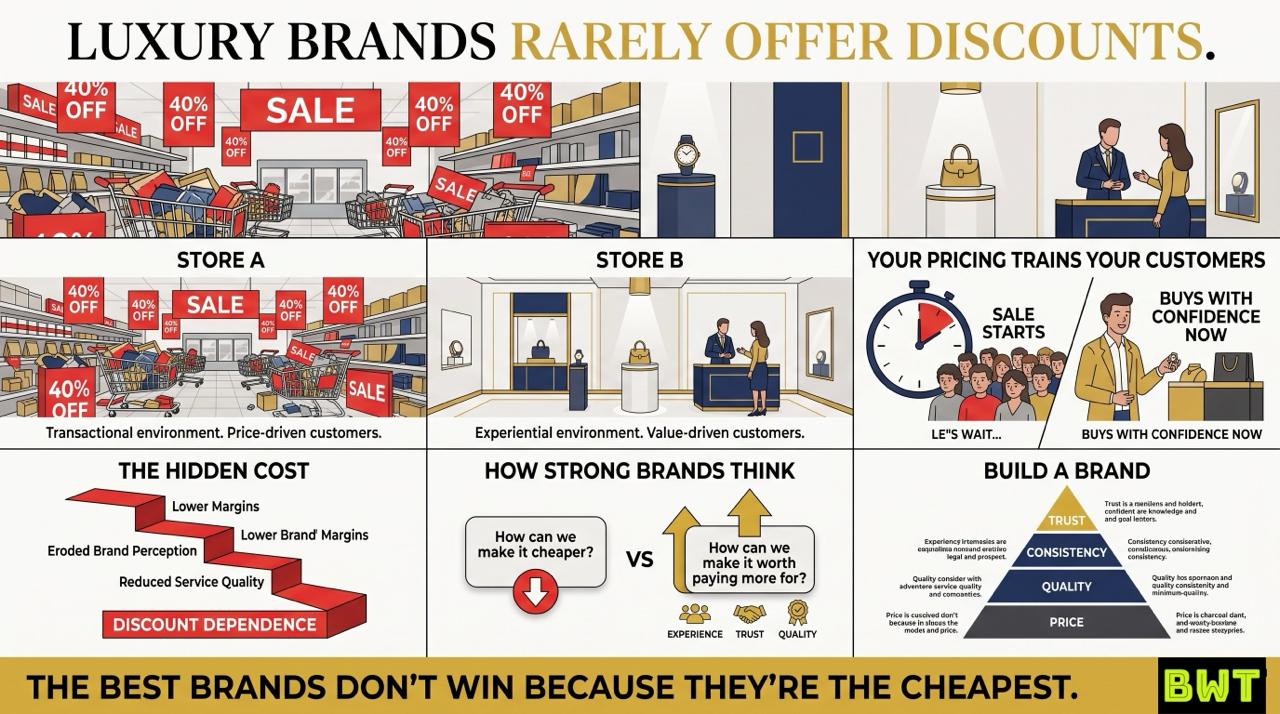
When consumers repeatedly see “40% OFF,” “Buy One Get One Free,” or “Sale Ends Tonight,” they can gradually change the way they evaluate the brand. Instead of asking whether the product is worth its regular price, they may begin asking a very different question:
“When will it go on sale again?”
That distinction matters because pricing does more than determine revenue. It communicates something about the product, the company and the confidence a business has in the value it provides.
Research into brand price premiumness supports this broader relationship: consumers can associate higher prices with attributes such as quality, value, prestige and exclusivity.
For businesses trying to build a premium or differentiated brand, the challenge therefore isn’t simply deciding how much to charge.
It’s creating enough value that customers understand why the price is worth paying.
Your Pricing Strategy Is Also a Brand Strategy
Imagine two businesses selling comparable products.
The first surrounds the customer with promotional messages:
40% OFF. Limited-time deal. Special price. Buy two and get one free.
The second presents its product differently.
There is a carefully designed buying experience, clear product information, strong customer service, quality presentation and confidence in the price.
Even before comparing the products closely, customers can form different impressions of the two businesses.
That’s because price isn’t interpreted in isolation.
Consumers use many signals when evaluating an unfamiliar product: reputation, presentation, reviews, service, packaging, experience and, in some circumstances, price itself.
Research has found that price can contribute to brand associations involving premium quality and exclusivity. Other research into promotional framing has also found that quality inferences can affect how consumers interpret discounted offers.
This doesn’t mean expensive automatically equals good.
It means pricing becomes part of the story customers tell themselves about a brand.
The Hidden Problem With Constant Discounting
A promotion can produce an immediate sales increase while creating a more complicated long-term effect.
Customers learn.
If a retailer predictably reduces prices every few weeks, paying full price becomes less attractive. Consumers have more reason to postpone a purchase because previous behaviour from the retailer suggests another opportunity may arrive.
Research into retail promotions has found that promotional structures can increase consumers’ discount expectations. Research on reference effects similarly shows circumstances in which consumers may wait for a later discounted period instead of purchasing at full price.
This creates a dangerous cycle:
1. A business introduces a discount to increase conversions.
2. Sales improve during the promotion.
3. Full-price sales subsequently appear weaker.
4. Another promotion is introduced to restore sales.
5. Customers become increasingly accustomed to promotional prices.
6. The business becomes more dependent on discounting.
Eventually, the promotional price risks becoming the customer’s psychological benchmark.
The regular price may still appear on the website, but customers no longer necessarily perceive it as the price they should actually pay.
Discounts Aren’t the Enemy
Businesses shouldn’t interpret this as an argument for eliminating promotions altogether.
Discounts can be extremely useful.
They can help businesses clear old inventory, introduce new customers to a product, respond to seasonal demand, reward loyal customers or support a carefully planned campaign.
The distinction is between strategic discounting and discount dependency.
A strategic promotion has a specific purpose.
Discount dependency exists when a company struggles to generate demand without reducing the price.
That distinction is particularly important for brands trying to occupy a premium position.
Recent developments in luxury also show why the subject is more nuanced than simply saying premium companies never discount. Luxury companies have faced pressure from substantial price increases, softer demand and changing perceptions of value, while some brands have simultaneously worked to reduce reliance on markdowns and strengthen products and experiences.
The lesson isn’t “never lower your price.”
It’s never allow lower prices to become your only competitive advantage.
What Premium Brands Sell Beyond the Product
Why will someone pay considerably more for one product when a cheaper alternative performs a similar basic function?
Because customers rarely purchase functionality alone.
They can also purchase confidence, convenience, craftsmanship, identity, design, reputation, service, scarcity, community and experience.
This is where brand building changes the pricing conversation.
A weak value proposition asks:
“How much cheaper can we make this?”
A stronger value proposition asks:
“What can we improve so customers are comfortable paying this price?”
That could mean improving the actual product.
But it could equally mean improving delivery, support, packaging, guarantees, website experience, expertise, personalization or after-sales service.
The goal is not artificially increasing prices to appear premium.
The goal is increasing perceived and delivered value before asking customers to pay a premium.
This Principle Applies Beyond Luxury Retail
The same principle matters for service businesses.
Consider two web development companies.
One markets itself primarily through:
“50% OFF Website Design.”
“Cheapest Website Package.”
“Limited-Time Web Development Offer.”
Another demonstrates its expertise through case studies, technical knowledge, transparent processes, professional design, measurable results, testimonials and reliable support.
The first company makes price the comparison point.
The second gives prospective customers several other reasons to evaluate it.
This applies to digital marketing agencies, SaaS companies, consultants, healthcare providers, educational businesses, manufacturers and professional services.
If price is the only visible difference between you and a competitor, customers have little reason not to choose whoever charges less.
Strong branding gives them other reasons.
Build Value Before You Defend Price
Businesses that want to reduce their reliance on discounts should not simply remove promotions overnight and expect customers to continue buying.
They need to strengthen the value surrounding the price.
That means focusing on areas such as product excellence, differentiation, customer experience, trust, expertise, consistent branding and post-purchase service.
A company’s website plays an increasingly important role here.
If you claim premium quality but your website looks outdated, loads poorly, provides weak product information or makes it difficult to contact the company, customers receive conflicting signals.
Likewise, strong SEO may generate traffic, but visibility alone doesn’t establish premium positioning.
Every digital touchpoint should reinforce the same message:
This business knows what it does, delivers it well and can explain why its offering is worth the price.
The Question Every Business Should Ask
There is a useful test for any pricing strategy:
If we removed our discounts tomorrow, would customers still choose us?
If the answer is yes, you probably have something stronger than promotional pricing supporting demand.
If the answer is no, the next question shouldn’t automatically be:
“What bigger discount should we offer?”
It should be:
“What value are customers currently missing?”
That question can uncover weaknesses in the product, positioning, customer experience, website, communication or overall brand.
Price Can Generate a Transaction. Value Builds the Brand.
A discount can attract attention quickly.
But attention and brand equity aren’t the same thing.
Sustainable brands give customers reasons to purchase that extend beyond today’s promotional banner. They make the product desirable, the experience credible and the price understandable.
The objective isn’t to become the most expensive company in your market.
Nor is it to abandon discounts completely.
It is to reach a position where customers choose you because of the value they expect to receive—not simply because you happen to be cheaper today.
That’s the difference between continually selling on price and building a brand capable of defending its value.