
By Bhavya Web Technologies
One of the most common assumptions in ecommerce is:
“Our products aren’t selling because the price is too high.”
Sometimes that’s true.
But surprisingly often, price isn’t the real problem.
The real problem is uncertainty.
Customers aren’t saying:
“This product is too expensive.”
They’re thinking:
“I’m not sure I should trust this purchase.”
And those are two completely different objections.
The Hidden Conversion Killer: Doubt
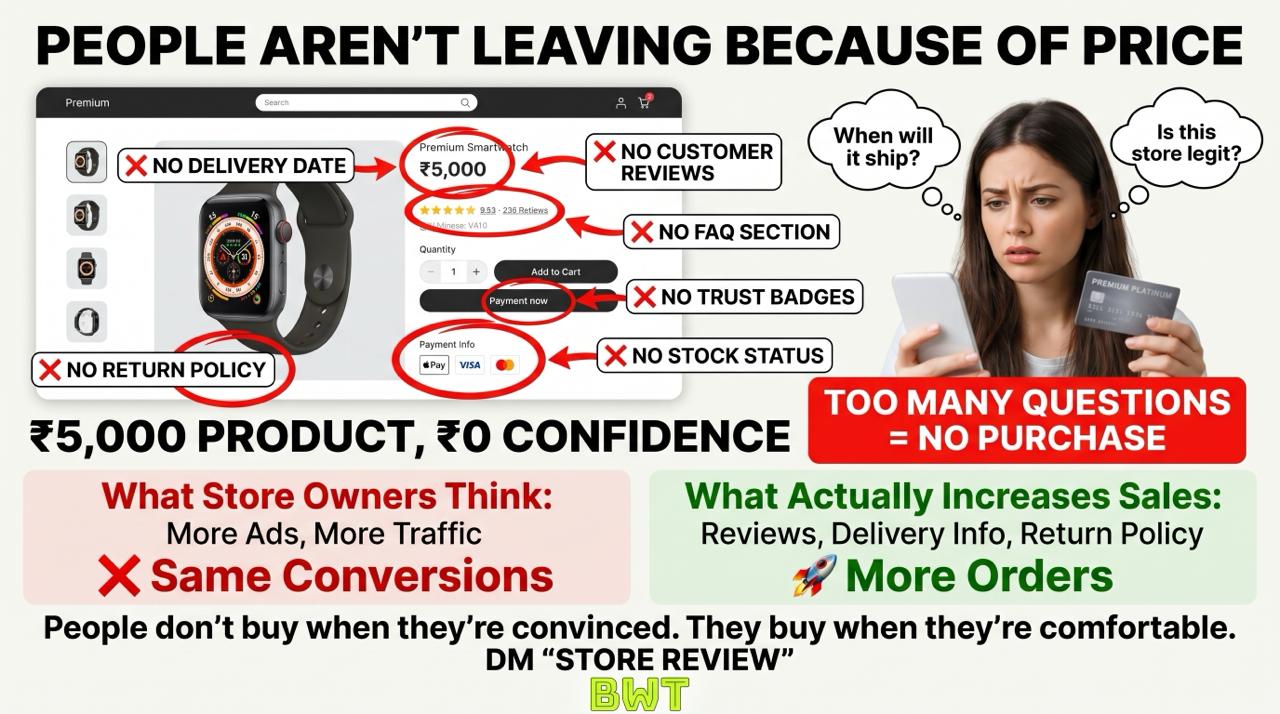
Imagine you’re about to buy a product online for ₹5,000.
You like the product.
The design looks good.
The price seems reasonable.
You click the product page.
But immediately you notice:
❌ No delivery information
❌ No return policy
❌ No customer reviews
❌ No stock availability
❌ No FAQ section
❌ No trust indicators
Would you buy?
Most people wouldn’t.
Not because of the price.
Because of the uncertainty.
Customers Don’t Buy Products. They Buy Confidence.
Every online purchase involves risk.
The customer asks questions like:
- Will this product arrive?
- How long will delivery take?
- What if I don’t like it?
- What if it’s damaged?
- Can I return it?
- Is this website legitimate?
- Have other people bought from here?
When those questions remain unanswered, hesitation grows.
And hesitation kills conversions.
Why More Traffic Doesn’t Always Mean More Sales
Many ecommerce store owners respond to poor sales by increasing:
- ad budgets
- influencer campaigns
- social media promotions
- SEO efforts
More visitors arrive.
But sales remain flat.
Why?
Because traffic amplifies existing problems.
If customers don’t trust the buying experience, more traffic simply means more people leaving.
Before spending more on acquisition, fix the reasons people hesitate.
The Real Formula for Ecommerce Growth
Many stores operate like this:
More Ads = More Sales
A more accurate formula is:
Traffic + Trust + Clarity = More Sales
Without trust, traffic becomes expensive.
Without clarity, visitors postpone decisions.
Without confidence, customers abandon carts.
Five Elements That Increase Purchase Confidence
1. Customer Reviews
Reviews provide social proof.
They answer a crucial question:
“Have other people successfully bought this product?”
Even a few genuine reviews can significantly improve trust.
Include:
- customer ratings
- written feedback
- photos when possible
Real experiences reduce uncertainty.
2. Delivery Information
One of the most common reasons for hesitation is not knowing when an item will arrive.
Clearly display:
- estimated delivery dates
- shipping timelines
- delivery regions
Customers prefer certainty.
Even if delivery takes several days, knowing the timeline is reassuring.
3. Return and Refund Policies
A visible return policy lowers perceived risk.
People buy more confidently when they know they have options if something goes wrong.
Don’t hide return information in the footer.
Place it near:
- product descriptions
- add-to-cart buttons
- checkout areas
4. Stock Availability
Customers want to know:
- Is it available now?
- Will it ship immediately?
- Should I order today?
Stock visibility helps buyers make faster decisions.
Examples:
✅ In Stock
✅ Ships Within 24 Hours
✅ Only 5 Units Remaining
These small details can increase urgency and confidence simultaneously.
5. Trust Signals
Trust indicators reassure buyers.
Examples include:
- secure payment badges
- SSL certificates
- verified reviews
- customer testimonials
- business contact information
- WhatsApp support
- return guarantees
These signals communicate legitimacy.
And legitimacy drives conversions.
Every Unanswered Question Costs Money
Let’s compare two product pages.
Store A
- No reviews
- No delivery timeline
- No return policy
- Generic product description
- No FAQ section
Customer reaction:
“I’m not sure.”
Store B
- Verified reviews
- Delivery estimate
- Easy returns
- Detailed FAQ
- Secure payment badges
Customer reaction:
“This feels safe.”
Both stores may sell the same product at the same price.
The difference is confidence.
And confidence wins.
The Highest-Converting Stores Remove Uncertainty
Successful ecommerce brands understand something important:
Customers rarely need more persuasion.
They need fewer doubts.
That’s why top-performing stores invest heavily in:
- product education
- transparency
- customer support
- trust building
- social proof
They focus on removing questions before customers ask them.
Conduct a Product Page Confidence Audit
Open one of your product pages right now.
Pretend you’re a first-time customer.
Ask yourself:
Can I easily find:
✅ Delivery information?
✅ Return policy?
✅ Customer reviews?
✅ Product specifications?
✅ Contact information?
✅ Payment security details?
If not, you’ve discovered opportunities to improve conversions.
Stop Obsessing Over Price Alone
Price matters.
But trust often matters more.
Customers regularly pay more to buy from businesses they trust.
They frequently avoid cheaper options that feel risky.
That’s why two stores can sell similar products at different prices and still achieve very different conversion rates.
The winner isn’t always the cheapest.
It’s usually the most trustworthy.
Final Thought
Most ecommerce businesses don’t have a traffic problem.
They have a confidence problem.
Every unanswered question creates friction.
Every doubt reduces conversions.
Every missing trust signal makes customers hesitate.
Before spending another ₹10,000 on ads, ask yourself:
What questions does a customer still have before buying from me?
Because sales don’t happen when people are convinced.
They happen when people feel comfortable.
And comfort comes from clarity, transparency, and trust.
Bhavya Web Technologies
Kukatpally, Hyderabad