
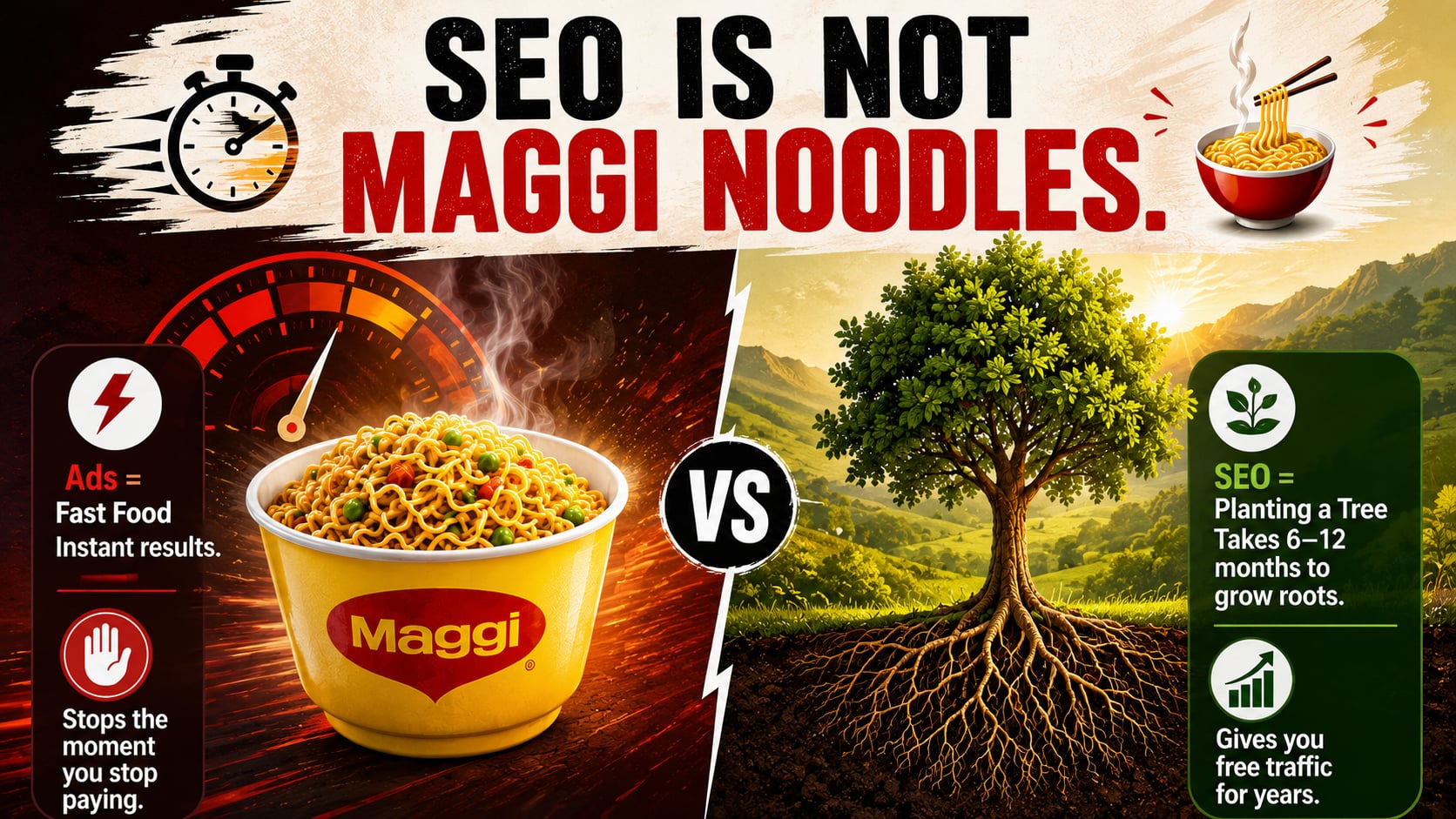
SEO Isn’t Instant Noodles
SEO takes time because sustainable search visibility is built through consistent improvements, useful content, technical performance, authority, and trust. Unlike paid advertising, where businesses can purchase immediate visibility, SEO is about creating a long-term digital asset that can continue attracting potential customers over time.
One of the biggest mistakes businesses make with digital marketing is expecting SEO to behave like paid advertising.
A campaign goes live today, so they expect rankings tomorrow.
A few blog posts are published, so they expect enquiries next week.
When those results don’t appear immediately, the conclusion is often:
“SEO isn’t working.”
But SEO was never designed to be an instant-results channel.
Think of paid advertising as switching on a tap. You can generate visibility quickly, but that visibility is closely connected to continued spending.
SEO is more like planting and developing a tree.
You prepare the ground, establish the roots, maintain it consistently, and allow it to grow.
Over time, those efforts can create something much more valuable: sustainable organic visibility.
Paid Ads vs SEO: Two Different Growth Strategies
Paid advertising and SEO are sometimes treated as competing strategies.
They shouldn’t be.
They solve different marketing problems.
Paid Advertising: Speed and Immediate Visibility
Paid advertising can be extremely effective when a business needs to:
- Generate traffic quickly
- Promote a new product or service
- Test an offer or landing page
- Reach a specific audience
- Generate demand during a campaign
- Support short-term sales objectives
You create a campaign, set a budget, target an audience, and potentially begin receiving traffic almost immediately.
The limitation is simple.
When the campaign stops, the paid traffic generated by that campaign generally stops as well.
You are essentially paying for continued access to attention.
SEO: Building Long-Term Discoverability
SEO works differently.
Instead of purchasing each visit, you invest in making your website more useful, authoritative, accessible, and relevant to the people searching for what you offer.
That involves areas such as:
Keyword research, technical SEO, content strategy, website performance, internal linking, user experience, authority building, structured information, and conversion optimization.
The objective isn’t simply to get a page ranked.
The objective is to build a digital presence that search engines—and increasingly AI-powered discovery systems—can understand and trust.
Why Does SEO Take Time?
There is no universal rule that says SEO will take exactly three, six, or twelve months.
Every website starts from a different position.
A well-established business with years of authority may see improvements faster than a brand-new domain entering an extremely competitive market.
Several factors influence the timeline.
1. Your Existing Website Authority
An established website may already have backlinks, indexed pages, branded searches, useful content, and a history with search engines.
A new website starts with much less information and authority.
That foundation takes time to develop.
2. Competition in Your Industry
Ranking for a highly specific local service can be very different from competing nationally for terms dominated by established brands.
The stronger your competitors’ websites, content, authority, and reputation, the more work may be required to compete effectively.
3. Content Quality
Publishing more articles isn’t automatically better SEO.
Content needs to answer genuine customer questions.
Instead of asking:
“How many blogs should we publish?”
Businesses should ask:
“What does our customer need to understand before choosing us?”
Those questions can become valuable service pages, product information, guides, FAQs, case studies, comparison pages, and educational articles.
4. Technical Website Quality
Excellent content on a poorly functioning website can still struggle.
A strong SEO foundation should consider areas such as:
→ Mobile usability
→ Page performance
→ Crawlability
→ Indexation
→ Site architecture
→ Internal links
→ Structured data where appropriate
→ Duplicate or thin content
→ Broken links and redirects
SEO isn’t something added to a website after development.
The website itself is part of the SEO strategy.
5. Trust and Authority
Search visibility isn’t created by repeating a keyword dozens of times.
Businesses need to demonstrate why their information deserves attention.
That can come from original expertise, useful resources, credible mentions, customer evidence, case studies, clear company information, relevant backlinks, and consistent brand signals.
Building genuine authority takes time.
And that’s difficult to shortcut.
The Real SEO Mistake: Giving Up Too Early
Imagine planting a tree.
You water it for several weeks.
Nothing dramatic appears above the ground.
So you stop watering it.
Then you conclude:
“Trees don’t work.”
That’s how some businesses approach SEO.
They optimize several pages, publish a handful of articles, wait briefly, and stop because rankings haven’t dramatically changed.
But much of the early work is building the foundation.
Technical problems are corrected.
Search engines discover and process pages.
Content coverage expands.
Internal relationships between pages improve.
Authority develops.
Search intent becomes clearer.
Eventually, those individual improvements can begin working together.
SEO growth is often cumulative rather than immediate.
SEO Is More Than Google Rankings
Another important change is happening.
SEO can no longer be viewed purely as:
Keyword → Google Ranking → Click
Customer discovery is becoming more fragmented.
People may discover businesses through Google, maps, videos, review platforms, social platforms, marketplaces, and AI-powered search and recommendation experiences.
This makes clarity even more important.
Your digital presence should clearly communicate:
What do you offer?
Who is it for?
Why should someone trust you?
What expertise do you have?
What evidence supports your claims?
How can someone take the next step?
A technically optimized website that doesn’t clearly answer these questions may generate visibility without generating enough business value.
Traffic Alone Isn’t the Goal
Ranking number one can feel like success.
But if the traffic doesn’t turn into enquiries, purchases, appointments, downloads, or other meaningful actions, the ranking has limited business value.
SEO should connect directly to the customer journey.
For example:
Search → Helpful Page → Trust → Clear Offer → CTA → Enquiry
This is why SEO and website conversion optimization should work together.
A page shouldn’t simply attract a visitor.
It should help that visitor understand what to do next.
Should Businesses Choose SEO or Paid Ads?
For many businesses, the strongest strategy isn’t choosing one.
It’s using both strategically.
Paid advertising can create immediate visibility while SEO develops longer-term organic visibility.
For example:
Short term: Paid campaigns generate targeted traffic.
Medium term: SEO content begins capturing relevant searches.
Long term: A stronger organic presence reduces dependence on purchasing every visit.
The exact mix depends on the business, competition, margins, customer acquisition costs, sales cycle, and marketing objectives.
The important point is to stop expecting both channels to behave identically.
What a Sustainable SEO Strategy Looks Like
A strong SEO strategy isn’t:
“Publish 20 AI-generated blogs every month and hope something ranks.”
It starts with understanding the business.
At Bhavya Web Technologies, we approach SEO around the relationship between search visibility, website quality, customer intent, and conversion.
A sustainable strategy can include:
→ Understanding customer search behaviour
→ Identifying commercially relevant topics
→ Improving website architecture
→ Fixing technical SEO problems
→ Creating useful, experience-driven content
→ Strengthening important service and product pages
→ Improving internal linking
→ Building authority and trust signals
→ Improving website speed and usability
→ Measuring enquiries and conversions—not only rankings
→ Continuously improving based on performance data
The goal isn’t simply more traffic.
The goal is more relevant visibility that contributes to business growth.
Don’t Measure SEO Only by Rankings
Rankings matter, but they shouldn’t be the only measurement.
Businesses should also monitor:
→ Organic impressions
→ Relevant search visibility
→ Organic clicks
→ Engagement with important pages
→ Leads and enquiries
→ Ecommerce revenue
→ Conversion rates
→ Branded search growth
→ Assisted conversions
→ Quality of organic leads
A website could increase organic traffic significantly and still produce poor commercial results if it attracts the wrong audience.
Good SEO connects visibility with business intent.
SEO Is an Investment in Discoverability
Paid advertising can buy immediate attention.
SEO builds the foundation for being discovered organically.
Both can be valuable.
But they operate on different timelines.
If you expect SEO to behave like an instant advertising campaign, you’ll probably become frustrated.
If you treat it as a long-term investment in your website, content, authority, customer experience, and digital reputation, the strategy makes much more sense.
So remember:
SEO isn’t instant noodles.
You don’t add a few keywords, wait two minutes, and expect first-page rankings.
You build.
You publish.
You optimize.
You measure.
You improve.
And you keep strengthening the digital asset.
Because sustainable SEO isn’t about chasing quick rankings.
It’s about becoming easier to find, easier to understand, easier to trust, and ultimately easier to choose.
Ready to Build Sustainable Organic Growth?
If your website isn’t generating enough organic visibility, qualified traffic, or enquiries, adding more content without a clear strategy may not solve the problem.
Bhavya Web Technologies helps businesses improve SEO through better website foundations, strategic content, technical optimization, user experience, and conversion-focused thinking.
Want to know what’s holding your website back?
💬 DM “SEO” for an SEO review.
Bhavya Web Technologies
Building SEO strategies for long-term visibility, qualified traffic, and sustainable business growth.