
Bhavya Web Technologies
One of the first questions businesses ask before starting a website project is:
“Should we build it in WordPress or Next.js?”
It’s a reasonable question.
But it’s usually the wrong place to start.
Choosing a technology before understanding your business goals is like choosing between a truck and a sports car without knowing what you need to transport.
The better question is:
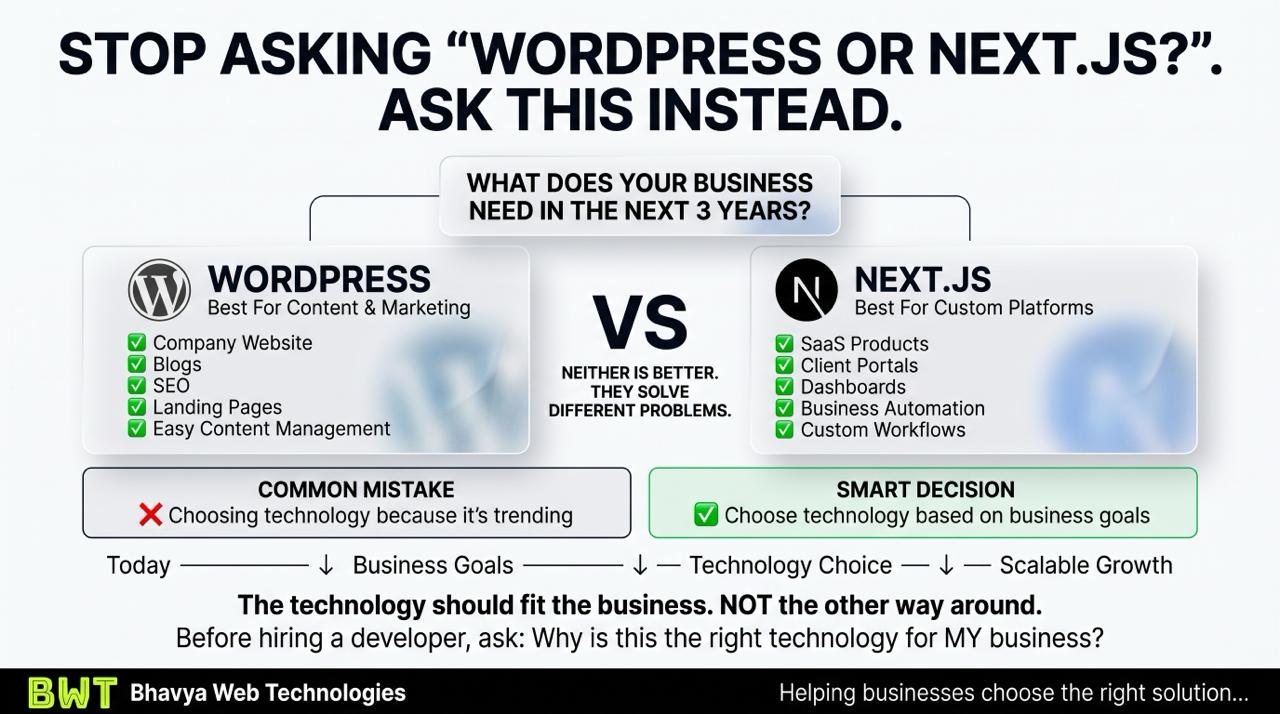
“What does our business need to achieve over the next three years?”
Once you know the destination, choosing the right technology becomes much easier.
Technology Should Follow Business Goals
Many businesses select a platform because:
- It’s popular.
- A competitor uses it.
- A developer recommended it.
- It’s trending on social media.
Unfortunately, technology trends don’t guarantee business success.
The right platform depends on what you’re trying to build, how you plan to grow, and how your customers will use it.
A website is a business tool—not a technology showcase.
When WordPress Is the Right Choice
WordPress powers a significant portion of the web because it’s excellent for businesses that rely on content, marketing, and easy website management.
WordPress is often the right solution if your business needs:
A Professional Company Website
For businesses that primarily need an online presence, WordPress provides a flexible and cost-effective foundation.
It allows companies to launch quickly while maintaining a professional appearance.
Blogging and Content Marketing
If SEO and content marketing are central to your growth strategy, WordPress offers one of the strongest publishing experiences available.
Publishing blogs, guides, news updates, and case studies is simple—even for non-technical teams.
Search Engine Optimization
WordPress supports a wide range of SEO tools that make it easier to optimize pages, manage metadata, improve internal linking, and publish search-friendly content.
For businesses focused on organic traffic, this can be a major advantage.
Landing Pages
Marketing campaigns often require dedicated landing pages.
WordPress makes it easy to create, update, and test landing pages without extensive development work.
Easy Content Management
One of WordPress’s biggest strengths is that business owners and marketing teams can update content themselves.
That reduces ongoing development costs and speeds up day-to-day operations.
When Next.js Is the Better Choice
Some businesses need much more than a traditional website.
They need custom software.
That’s where Next.js becomes a powerful option.
SaaS Platforms
Software-as-a-Service products often require:
- user authentication
- subscription management
- complex application logic
- high performance
Next.js is well suited for building scalable SaaS applications.
Client Portals
Businesses that need secure customer dashboards, portals, or account management systems benefit from the flexibility of Next.js.
Examples include:
- financial dashboards
- healthcare portals
- learning platforms
- customer service portals
Business Dashboards
Companies often need internal systems for reporting, analytics, and operational management.
Next.js enables developers to build highly interactive dashboards with excellent performance.
Business Automation
When your website becomes part of your operational workflow, custom development becomes increasingly valuable.
Examples include:
- CRM integrations
- automated approvals
- quotation systems
- workflow management
- inventory synchronization
These requirements often extend beyond what traditional content management systems are designed to handle.
Custom Workflows
Every business operates differently.
If your competitive advantage depends on unique processes, a custom-built application may provide far greater flexibility than a standard website platform.
Neither Technology Is Better
One of the biggest misconceptions in web development is that one technology is universally superior.
The reality is much simpler.
They solve different problems.
WordPress is exceptional for businesses focused on:
- marketing
- publishing
- SEO
- content management
Next.js excels when businesses require:
- custom applications
- complex integrations
- interactive user experiences
- scalable software platforms
Comparing them directly is like comparing a publishing platform with an application framework.
Each has its purpose.
The Cost of Choosing the Wrong Technology
Selecting the wrong platform can create long-term challenges.
Businesses may experience:
- higher maintenance costs
- slower website performance
- limited scalability
- integration difficulties
- expensive rebuilds
- unnecessary development complexity
These issues rarely appear during launch.
They usually emerge as the business grows.
That’s why technology decisions should consider future requirements—not just today’s needs.
Think Beyond the Launch
Before approving a new website project, consider where your business will be in three years.
Ask questions like:
- Will we launch new services?
- Will customers need secure logins?
- Will we sell products online?
- Will we automate business processes?
- Will marketing publish content regularly?
- Will our team update the website frequently?
Your answers will shape the technology that makes the most sense.
Questions Every Business Should Ask
Before hiring a web development agency, ask:
- Why is this technology the best fit for our business?
- What business problems does it solve?
- How will it support future growth?
- Can our team manage it easily?
- What happens if our requirements change?
- Will this scale with our business?
If the answer is simply:
“Because it’s popular.”
Keep asking questions.
A good technology recommendation should always connect directly to business objectives.
Choose the Solution—Not the Trend
Technology evolves quickly.
Business goals tend to last much longer.
Instead of asking:
“Should we use WordPress or Next.js?”
Ask:
“What platform gives our business the best chance to succeed over the next three years?”
That single question changes the entire conversation.
Instead of chasing trends, you’ll be investing in a solution that supports growth, improves efficiency, and delivers long-term value.
Final Thought
The best technology isn’t the newest.
It isn’t the most popular.
And it isn’t the one your competitors are using.
The best technology is the one that helps your business achieve its goals with the least complexity and the
greatest flexibility.
Because successful digital projects don’t begin with choosing a framework.
They begin with understanding the business.
Choose your business strategy first.
Choose your technology second.
That’s how scalable digital solutions are built.
Bhavya Web Technologies
Kukatpally, Hyderabad