
by Bhavya Web Technologies
When businesses request a website proposal, the first question is almost always:
“How much will it cost?”
It’s an understandable concern.
Every business wants to invest wisely.
But there’s another question that’s far more important:
“Will this website still support my business two or three years from now?”
Because the true cost of a website isn’t measured by its initial price.
It’s measured by how long it continues to support your business before it needs to be rebuilt.
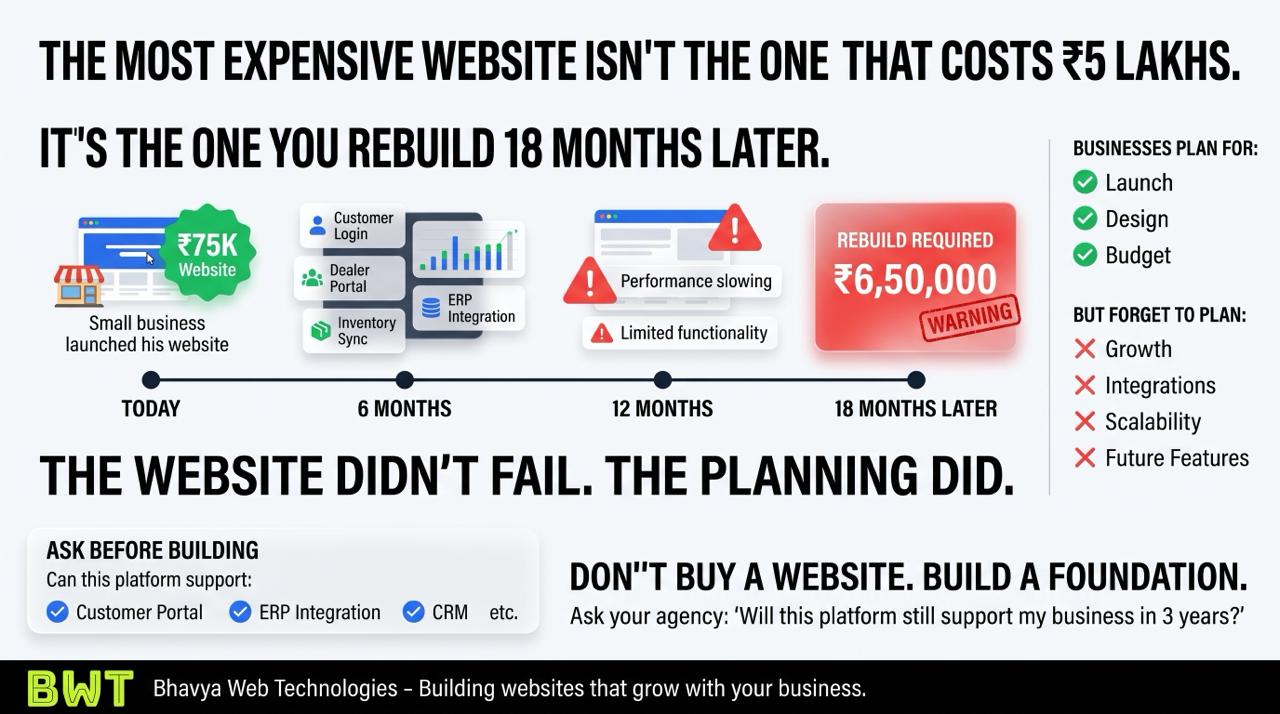
A website that costs ₹75,000 today but requires a complete rebuild after 18 months may end up costing far more than a thoughtfully planned solution built for long-term growth.
The Website Didn’t Fail. The Planning Did.
Most website projects focus heavily on launch.
Businesses discuss:
These are important decisions.
But they’re only part of the picture.
Very few businesses spend enough time discussing what happens after launch.
That’s where many expensive mistakes begin.
How Businesses Outgrow Their Websites
The first version of a website often meets today’s requirements perfectly.
It launches successfully.
Everything works.
Customers can browse services and submit enquiries.
Then the business starts growing.
Six months later, new requirements appear.
The company now needs:
Suddenly, the original website isn’t enough.
Not because it was poorly designed.
Because it was never planned for growth.
When “We’ll Have to Rebuild It” Becomes Expensive
Many businesses hear the same sentence after a year or two:
“Unfortunately, we’ll have to rebuild the website.”
Why?
Because the original platform wasn’t designed for:
At that point, you’re no longer paying for improvements.
You’re paying to start over.
That’s often the most expensive website you’ll ever own.
Build for Tomorrow, Not Just Today
A website should solve today’s business needs.
But it should also leave room for tomorrow’s opportunities.
When planning a new website, think beyond launch.
Ask questions like:
You may not need these features immediately.
But your platform should be capable of supporting them when the time comes.
Scalability Is a Business Decision
Scalability isn’t just a technical concept.
It’s a business strategy.
A scalable website allows your business to grow without forcing major redevelopment every time your requirements change.
That means:
Planning for scalability today often saves significant time and money later.
Think Beyond Design
Many website discussions revolve around appearance.
Businesses spend weeks selecting:
While visual design matters, it’s only one part of a successful website.
The more important conversations involve questions like:
These decisions influence your business for years.
Future Integrations Matter
Modern businesses rely on multiple digital tools.
Your website may eventually need to connect with:
Choosing a platform that supports these integrations reduces future development costs and operational complexity.
Performance Should Scale With Growth
As businesses grow, so do website demands.
More visitors.
More products.
More users.
More content.
More transactions.
A platform that performs well today should continue performing well as your business expands.
Ignoring performance planning often leads to slower websites, frustrated customers, and costly upgrades.
Questions Every Business Should Ask Before Starting
Before approving your next website project, ask your development team:
These questions often reveal more about the quality of a proposal than the price itself.
The Cheapest Proposal Isn’t Always the Best Value
A lower quote can be attractive.
But if it limits your business six months later, the savings disappear quickly.
A slightly higher investment in the right architecture may eliminate the need for an expensive rebuild later.
The goal isn’t simply to build a website.
It’s to build a digital platform that supports your business as it evolves.
Final Thought
Technology decisions are business decisions.
A website isn’t something you should replace every year or two.
It should grow alongside your company.
The most expensive website isn’t necessarily the one with the highest upfront cost.
It’s the one that forces you to rebuild because it wasn’t designed with the future in mind.
Before approving your next website project, don’t just ask:
“How much does it cost?”
Ask:
“Will this still support our business three years from now?”
That single question could save your business far more than negotiating a lower quotation.
Bhavya Web Technologies
Kukatpally, Hyderabad