
By Bhavya Web Technologies
A business owner invests ₹85,000 in a new website.
Then allocates ₹30,000 every month to Google Ads and social media campaigns.
Traffic starts flowing.
People click.
Visitors arrive.
But after three months, only a handful of enquiries come in.
The immediate reaction is predictable:
“Maybe we need to increase the ad budget.”
In many cases, that’s the wrong conclusion.
The issue isn’t getting people to your website.
It’s convincing them to stay, trust you, and take action once they’re there.
Traffic Without Trust Is Just Expensive Browsing
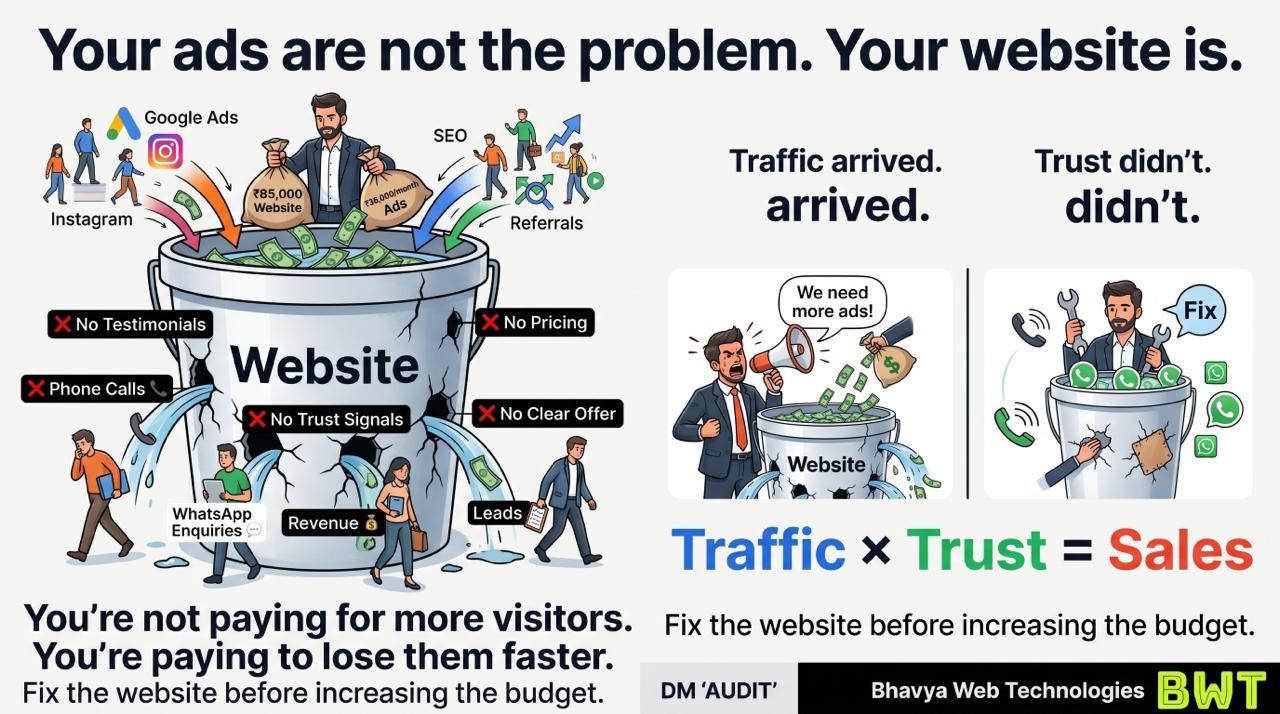
Think of your website as a bucket.
Advertising pours visitors into it.
If the bucket has holes, more water won’t solve the problem.
It will simply leak faster.
The same principle applies to digital marketing.
You can double your advertising budget, but if visitors don’t trust what they
see, they’ll leave without converting.
That’s why successful online marketing isn’t just about traffic.
It’s about what happens after the click.
Why Many Landing Pages Fail
A surprising number of business websites greet visitors with generic elements like:
- stock photography
- vague slogans
- abstract mission statements
- corporate buzzwords
- little evidence of real work
For a first-time visitor, the experience raises more questions than answers.
They wonder:
- What does this company actually do?
- Why should I choose them?
- Can I trust them?
- How do I get started?
- What happens if I contact them?
If your website doesn’t answer these questions quickly, visitors often leave—even if your product or service is excellent.
The Formula Most Businesses Get Wrong
Many companies believe:
Traffic = Sales
In reality, a more useful way to think about it is:
Traffic × Trust = Sales
If trust is weak, increasing traffic alone may not improve results.
Imagine two businesses receiving 1,000 visitors each.
- Business A clearly explains its services, displays customer testimonials, showcases real projects, and offers an easy way to get in touch.
- Business B uses generic messaging, has no reviews, no pricing guidance, and no visible proof of experience.
Even with identical traffic, Business A is far more likely to generate enquiries.
The difference isn’t marketing spend.
It’s credibility.
Five Website Elements That Build Trust
1. A Clear Value Proposition
Visitors should immediately understand:
- what you do
- who you help
- what outcome you deliver
For example:
❌ “Welcome to XYZ Company”
✅ “Custom Business Websites That Help Small Businesses Generate More Leads”
Clarity beats cleverness.
2. Genuine Customer Testimonials
People trust businesses that other people have trusted.
Include:
- customer names (with permission)
- company names
- measurable outcomes
- authentic feedback
Testimonials reduce perceived risk and help visitors feel more confident.
3. Real Project Images
Stock photos can make a site look polished, but they rarely prove capability.
Whenever possible, show:
- completed projects
- product photos
- team members
- office or workshop images
- before-and-after examples
Real visuals create authenticity.
4. Easy Contact Options
Don’t make visitors search for ways to reach you.
Prominently display:
- phone number
- enquiry form
- office location (if relevant)
Reducing friction often increases conversions.
5. Strong Calls-to-Action
Buttons like:
- “Submit”
- “Click Here”
- “Learn More”
don’t communicate value.
Instead, use action-oriented language such as:
- “Get a Free Quote”
- “Book a Consultation”
- “Request Pricing”
- “Talk to Our Team”
Tell visitors what they’ll gain by clicking.
Why More Ad Spend Can Make Things Worse
If your landing page isn’t converting, increasing your advertising budget may simply accelerate the problem.
More clicks on a confusing page lead to more lost opportunities.
Before investing additional money in traffic, optimize the destination.
Often, improving messaging and trust signals delivers a better return than buying more visitors.
A Quick Homepage Audit
Open your homepage and ask:
- Can a visitor understand what we do in five seconds?
- Is it obvious who our service is for?
- Do we explain why we’re different?
- Is there visible proof that customers trust us?
- Is contacting us easy?
If the answer to several of these questions is “no,” your website may be limiting the effectiveness of every marketing campaign you run.
Your Website Should Work as Hard as Your Ads
Advertising has one job:
Bring people to your website.
Your website has another:
Turn interest into action.
When those two work together, marketing becomes far more effective.
When they don’t, every click becomes more expensive.
Final Thought
It’s easy to assume poor lead generation means you need more traffic.
But often, the better investment is improving what visitors experience after they arrive.
A clear message.
Visible proof.
Simple navigation.
Strong calls-to-action.
These elements can make the difference between a visitor leaving in seconds and becoming your next customer.
Before increasing your ad budget, make sure your website gives people a compelling reason to stay.
Bhavya Web Technologies
Kukatpally, Hyderabad