
By Bhavya Web Technologies
A business owner once told me:
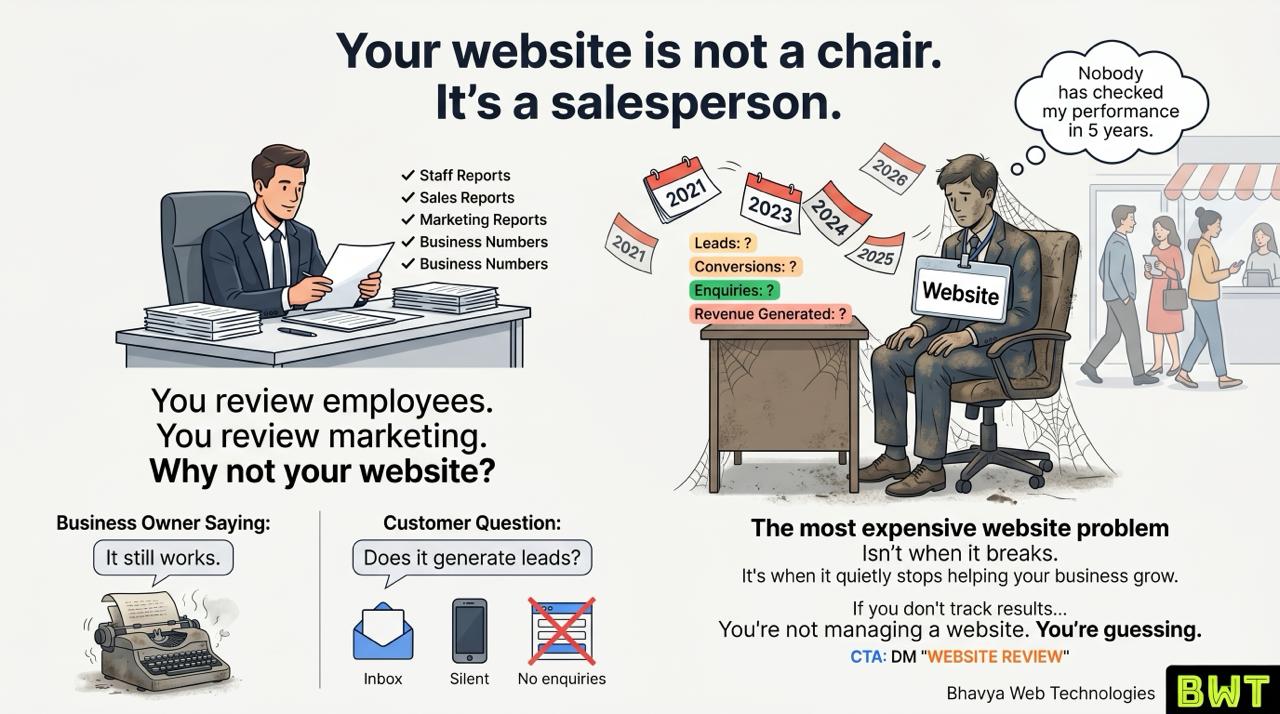
“Our website is five years old. It still works.”
That’s great—but here’s the better question:
How many enquiries did it generate last month?
For many businesses, the answer is silence.
Not because the website isn’t online.
But because nobody is measuring whether it’s actually helping the business grow.
Most Businesses Treat Their Website Like Furniture
Think about how you manage your office.
You review employee performance.
You track sales targets.
You monitor marketing campaigns.
You analyze revenue and expenses.
But what about your website?
For many companies, the website is launched once and then ignored for years unless something breaks.
That’s a missed opportunity.
Because a website isn’t a piece of furniture.
It’s one of your most important sales assets.
A Website Should Be Judged Like a Salesperson
Imagine hiring a salesperson and never asking:
- How many leads did you generate?
- How many prospects did you convert?
- How much revenue did you influence?
- Where are customers dropping off?
- How can your performance improve?
No business would operate that way.
Yet countless companies do exactly this with their websites.
They focus on appearance instead of outcomes.
The Most Expensive Website Problem Is Invisible
When a website goes offline, everyone notices.
But a far more costly problem is when it quietly underperforms.
It still loads.
The menus still work.
The contact form still exists.
Yet enquiries slowly decline because:
- messaging is outdated
- calls-to-action are weak
- trust signals are missing
- mobile usability has fallen behind
- competitors offer a better experience
The website looks fine—but stops contributing meaningfully to growth.
What Every Business Should Measure
A high-performing website isn’t judged by how modern it looks.
It’s judged by results.
Here are key metrics worth reviewing regularly:
1. Enquiries Generated
How many people contacted you through the website last month?
If you can’t answer this, you’re missing one of the most important indicators of success.
2. Conversion Rate
Out of all visitors, how many completed a meaningful action such as:
- requesting a quote
- booking a consultation
- filling out a contact form
- calling your business
A small improvement here can significantly increase revenue without increasing traffic.
3. Most Visited Pages
Which pages attract the most attention?
These pages deserve extra care because they often influence buying decisions.
4. Bounce Rate and Engagement
If visitors leave almost immediately, ask why.
Common causes include:
- unclear headlines
- slow loading times
- poor mobile experience
- lack of trust signals
- confusing navigation
5. Traffic Sources
Where are your best visitors coming from?
Understanding whether enquiries originate from search, social media, referrals, or paid ads helps allocate marketing budgets more effectively.
Review Your Website Like You Review Your Team
Businesses routinely hold:
- quarterly reviews
- sales meetings
- marketing audits
- financial assessments
Your website deserves the same attention.
At least once every quarter, evaluate:
- messaging
- page speed
- mobile usability
- lead generation
- conversion paths
- calls-to-action
- trust elements
- analytics
Continuous improvement often delivers better long-term results than waiting years for a complete redesign.
Five Questions Every Website Owner Should Be Able to Answer
If someone asked you today:
- How many enquiries did your website generate last month?
- Which page gets the most traffic?
- What percentage of visitors use mobile devices?
- Which call-to-action performs best?
- Where do most users leave your site?
Could you answer confidently?
If not, it may be time to start measuring performance more closely.
A Website That “Still Works” Isn’t Necessarily Working Well
Many business owners believe that because a website is online, it’s doing its job.
But there’s a difference between functioning and performing.
A functioning website loads pages.
A performing website generates leads, builds trust, and supports business growth.
That difference matters.
Simple Ways to Improve Website Performance
You don’t always need a full redesign.
Often, small updates make a noticeable impact:
- refresh your homepage headline
- add recent client testimonials
- showcase new project photos
- simplify enquiry forms
- improve mobile navigation
- make contact options more visible
- review analytics monthly
Regular optimization keeps your website aligned with customer expectations and business goals.
Final Thought
Your website shouldn’t be treated like office furniture that sits quietly in the background.
It should be treated like your best salesperson.
That means reviewing its performance, measuring its contribution, and continuously improving how it communicates with potential customers.
Because the most expensive website problem isn’t when it crashes.
It’s when it quietly stops generating opportunities—and nobody notices.
If you’re not tracking what your website is accomplishing, you’re not managing a digital asset.
You’re making assumptions.
Bhavya Web Technologies
Kukatpally, Hyderabad