
By Bhavya Web Technologies
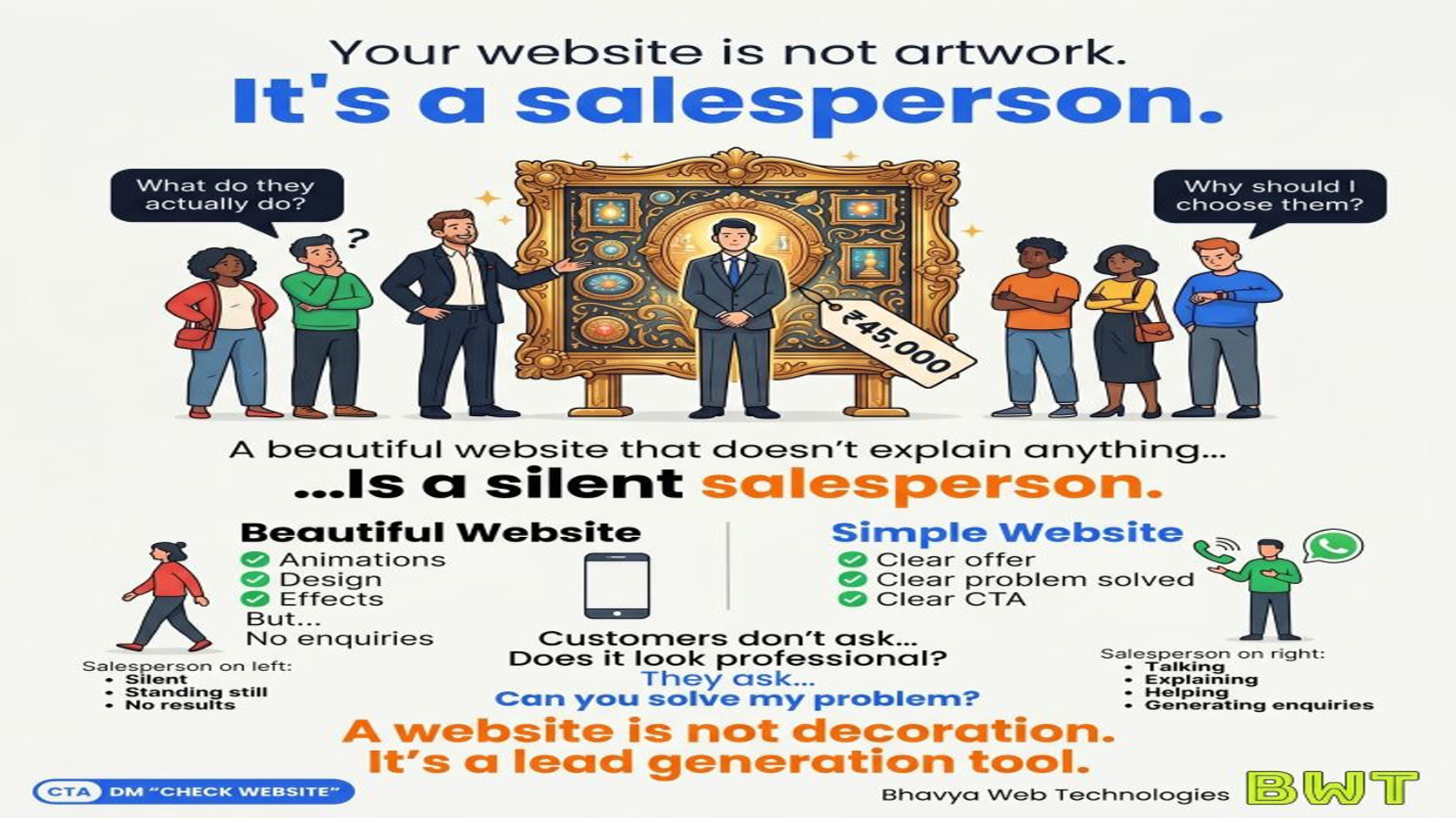
A business owner spends ₹45,000 on a website.
The design looks impressive.
Smooth animations.
Modern layout.
Premium graphics.
Everything feels professional.
Then they wait.
One month.
Three months.
Eight months.
And the enquiries never arrive.
Eventually, they reach a conclusion:
“Websites don’t work.”
But the real problem is usually something else.
The website was designed to look good.
Not to sell.
And those are two very different goals.
The Biggest Website Misunderstanding
Many businesses treat websites like digital artwork.
They focus on:
- colors
- animations
- effects
- visual trends
- design awards
While customers focus on something completely different.
They’re asking:
- What do you do?
- Can you help me?
- Why should I trust you?
- What should I do next?
If those answers aren’t immediately obvious, visitors leave.
No matter how beautiful the website looks.
A Website Is a Digital Salesperson
Imagine hiring a salesperson.
They greet every customer.
Stand in front of them.
Smile.
Look professional.
But never explain:
- what the company offers
- how the product helps
- why customers should choose it
- how to make a purchase
Would you keep paying that salesperson?
Probably not.
Yet many websites do exactly that.
They look impressive.
But they stay silent.
A silent salesperson never generates enquiries.
Why Beautiful Websites Often Fail
Design matters.
Professional presentation creates credibility.
But design is not the primary reason customers buy.
Customers buy because they understand value.
Many websites prioritize:
✅ Beautiful banners
✅ Modern layouts
✅ Fancy transitions
✅ Creative effects
But forget:
❌ Clear positioning
❌ Strong messaging
❌ Problem-solving language
❌ Conversion-focused calls to action
Visitors don’t convert because a website is attractive.
They convert because a website makes the next step obvious.
The Question Business Owners Ask vs The Question Customers Ask
This is where many websites fail.
Business Owner Question
“Does my website look professional?”
Customer Question
“Can you solve my problem?”
Those are completely different conversations.
Professional appearance creates a first impression.
Problem-solving creates enquiries.
The second one matters more.
What Every Homepage Must Explain
A visitor should understand three things within seconds.
1. What Do You Do?
Avoid vague statements like:
❌ “Leading Provider of Innovative Solutions”
Instead:
✅ “Business Websites Delivered in 7 Days”
Specific beats generic.
2. Who Do You Help?
Customers want to know whether the service is relevant to them.
Examples:
- Small businesses
- Manufacturers
- Healthcare clinics
- Educational institutions
Clarity creates connection.
3. Why Are You Different?
What makes your business the better choice?
Examples:
- Faster delivery
- Specialized expertise
- Better support
- Proven results
Differentiation reduces hesitation.
The Most Expensive Mistake: Making Visitors Think
Visitors arrive with questions.
If your website forces them to figure everything out themselves, they leave.
People don’t visit websites to solve puzzles.
They visit websites to solve problems.
The easier you make understanding, the easier you make buying.
That’s why simple messaging often outperforms complex design.
A Good Website Guides. A Great Website Sells.
Think of your homepage as a sales conversation.
A good salesperson naturally explains:
- the problem
- the solution
- the benefits
- the next step
our website should do the same.
Every section should move visitors closer to a decision.
Not distract them with unnecessary complexity.
The Three Elements of a Lead-Generating Website
Clear Offer
Tell people exactly what you provide.
Clear Problem Solved
Show how you improve their situation.
Clear Call-to-Action
Tell them what to do next.
Call.
Message.
Book.
Request a quote.
Start a consultation.
Never leave visitors guessing.
Before Spending More on Marketing
Many businesses invest heavily in:
- Google Ads
- SEO
- Social media campaigns
- Lead generation services
before fixing their website messaging.
That’s like pouring water into a leaking bucket.
More traffic doesn’t solve communication problems.
Clearer communication does.
Quick Homepage Test
Open your website.
Look only at the first screen.
Ask yourself:
Can a stranger immediately understand:
- What we do?
- Who we help?
- Why we’re different?
- What they should do next?
If the answer is no, your website may be functioning as a brochure instead of a salesperson.
And brochures rarely generate consistent enquiries.
Final Thought
A website is not decoration.
It’s not a digital trophy.It’s not an art project.
It’s a business tool.
Its purpose is not simply to look professional.
Its purpose is to create trust, communicate value, and generate enquiries.
Because customers don’t buy from the most beautiful website.
They buy from the website that helps them understand:
“This company can solve my problem.”
That’s the difference between a website that wins awards and a website that wins customers.
Bhavya Web Technologies
Kukatpally, Hyderabad