
By Bhavya Web Technologies
Most manufacturing and industrial business owners think their website is competing against other companies in their industry.
It isn’t.
In 2026, your biggest competitor is often something much simpler:
WhatsApp.
Because modern B2B buyers don’t behave the way they did ten years ago.
They don’t print brochures.
They don’t spend twenty minutes reading company profiles.
They don’t carefully study every page of your website.
They land on your website, scan it quickly, and decide:
“Should I contact this company?”
Or:
“Should I leave?”
That decision often happens in less than 15 seconds.
The Modern B2B Buyer Is Busy
Imagine a procurement manager looking for a supplier.
They may have:
- ten supplier websites open
- multiple emails waiting
- production deadlines approaching
- several quotations to compare
They’re not looking for a reading experience.
They’re looking for answers.
Fast.
That’s why most visitors don’t read websites.
They scan them.
Why Many Industrial Websites Fail
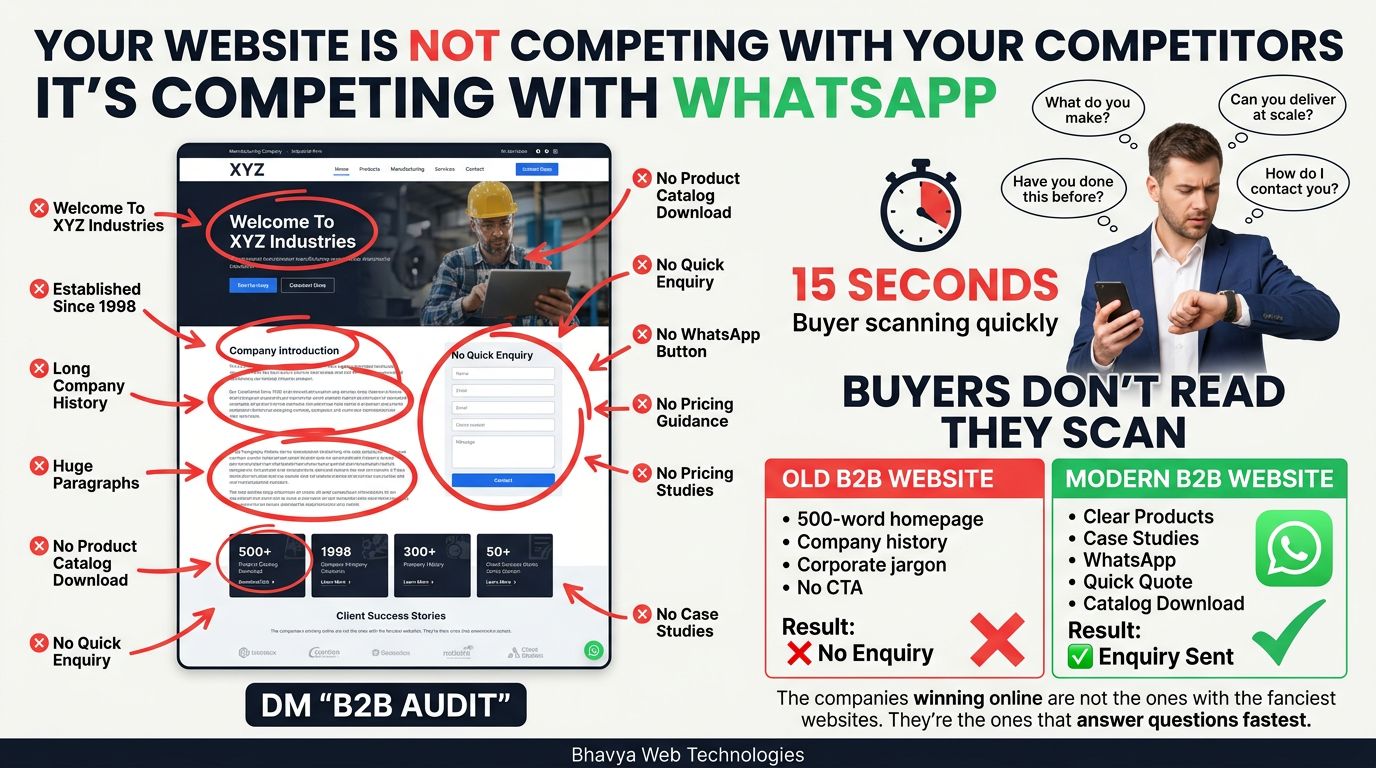
A surprising number of manufacturing websites still look like they were designed for a different era.
Their homepage starts with:
❌ Welcome to XYZ Industries
❌ Established Since 1998
❌ Company History
❌ Mission Statement
❌ Long Corporate Paragraphs
While all of that information may be accurate, it doesn’t answer the questions buyers actually have.
And unanswered questions lead to lost enquiries.
The Four Questions Every B2B Buyer Wants Answered
When a potential customer visits your website, they’re usually trying to answer four simple questions.
1. What Do You Make?
This should be obvious immediately.
Visitors shouldn’t have to dig through menus.
If you’re a manufacturer of industrial valves, fabrication equipment, automation systems, or precision components, say it clearly.
Examples:
✅ Industrial Valve Manufacturer
✅ Custom Sheet Metal Fabrication Services
✅ Pharmaceutical Automation Equipment
✅ Welding Equipment Supplier
Clarity creates confidence.
2. Can You Deliver at Scale?
Buyers need reassurance.
They want to know:
- production capacity
- service coverage
- delivery capability
- project handling experience
Show proof through:
- production facilities
- manufacturing capacity
- project statistics
- client industries served
3. Have You Done This Before?
Trust matters.
B2B buyers don’t want to be your experiment.
They want evidence.
That’s why:
- case studies
- project galleries
- client testimonials
- customer success stories
often outperform long company descriptions.
Proof is more persuasive than promises.
4. How Do I Contact You?
This sounds obvious.
Yet many websites make it surprisingly difficult.
Visitors should immediately see:
- phone number
- enquiry button
- email address
If contacting you requires multiple clicks, you’re creating friction.
And friction reduces enquiries.
Your Website Is Competing With Instant Communication
Years ago, websites were the primary destination.
Today, they’re often a checkpoint.
Many buyers simply want enough confidence to send a WhatsApp message.
That’s why a visible WhatsApp button can outperform an elaborate contact form.
Because it matches how buyers already communicate.
The faster someone can contact you, the more likely they are to do it.
The Old B2B Website Formula
Many industrial websites still follow this structure:
- 500-word homepage
- company history
- founder message
- mission statement
- generic services page
- hidden contact form
The result?
Visitors leave without taking action.
Not because the company isn’t capable.
Because the website doesn’t help them make a decision.
What Modern B2B Websites Do Differently
High-performing B2B websites focus on speed and clarity.
They typically include:
Clear Product Information
Visitors immediately understand what the company sells.
Case Studies
Proof of successful projects.
Catalog Downloads
Quick access to technical information.
Quick Quote Requests
Simple enquiry paths.
WhatsApp Integration
Instant communication.
Strong Calls-to-Action
Clear next steps for buyers.
The goal isn’t to impress visitors.
The goal is to help them act.
Buyers Don’t Care About Your Website. They Care About Their Problem.
This is a critical mindset shift.
Business owners often evaluate websites by asking:
“Does it look professional?”
Buyers evaluate websites by asking:
“Can this company solve my problem?”
Those are two very different questions.
The websites that win are the ones that answer buyer questions quickly.
Run the 15-Second Test
Open your homepage.
Set a timer for 15 seconds.
Now imagine you’re a procurement manager visiting for the first time.
Can you immediately understand:
✅ What the company does?
✅ What products it offers?
✅ Whether it looks trustworthy?
✅ How to contact the business?
If not, you’re asking visitors to work too hard.
And busy buyers rarely do.
The Fastest Website Wins
Not the fastest loading website.
The fastest understanding website.
The business that communicates clearly often receives the enquiry before competitors with better products, larger teams, or more experience.
Because online, speed of understanding creates speed of action.
And speed of action creates opportunities.
Final Thought
Your website is no longer competing solely with other businesses.
It’s competing with buyer attention.
It’s competing with busy schedules.
It’s competing with WhatsApp, email, LinkedIn, and dozens of other distractions.
That’s why the best B2B websites focus on one thing:
Answering buyer questions as quickly as possible.
Because buyers don’t reward complexity.
They reward clarity.
And in today’s market, the company that communicates fastest often wins first.
Bhavya Web Technologies
Kukatpally, Hyderabad