
By Bhavya Web Technologies
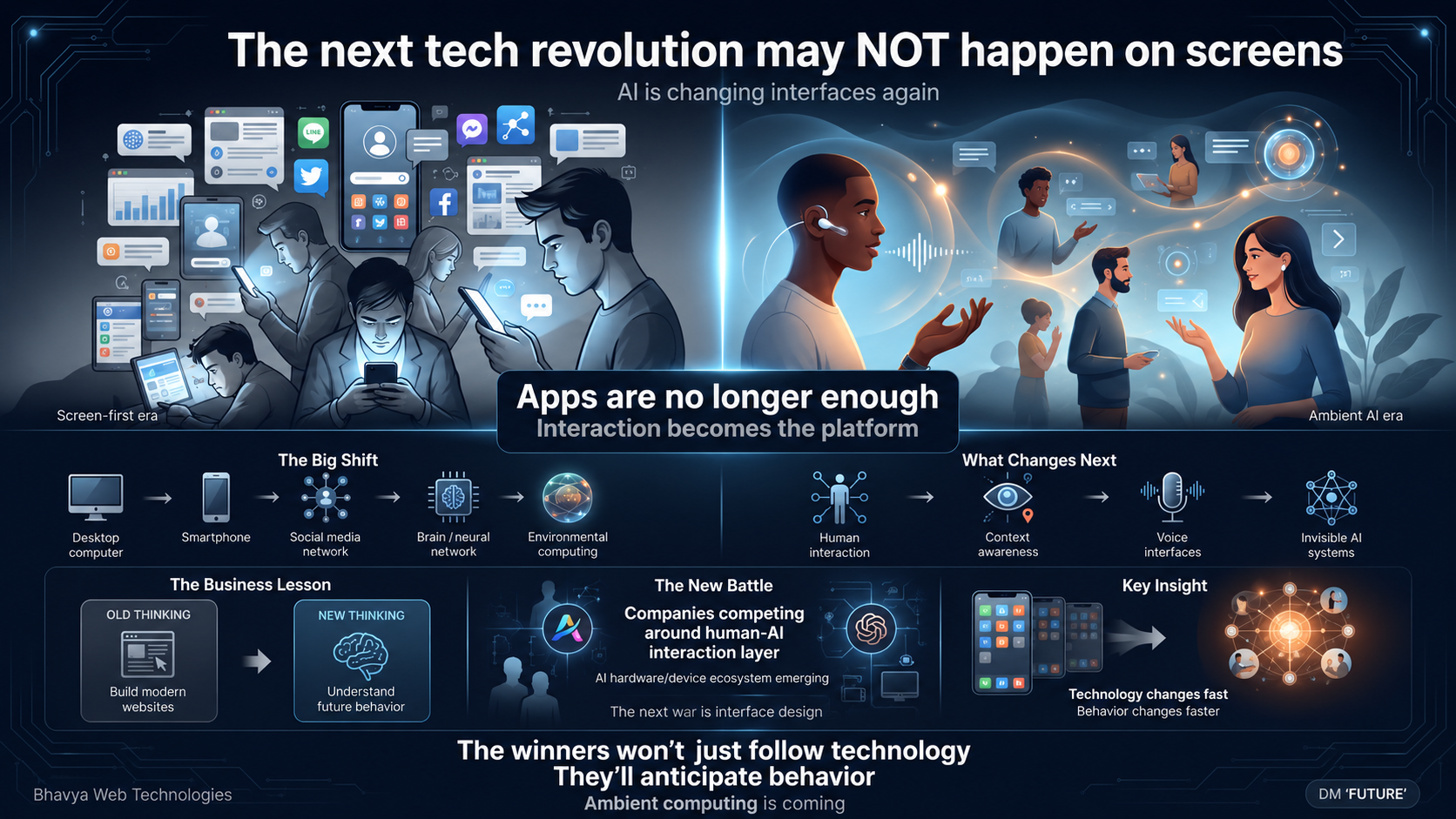
For the last 40 years, technology evolved through screens.
Desktop computers.
Smartphones.
Apps.
Social platforms.
Every major wave changed how people interacted with information.
Now another shift may be starting.
And it’s not necessarily about building better apps.
It may be about removing the interface entirely.
The Signal Everyone Is Watching
Recently, OpenAI expanded its hardware ambitions through its collaboration with legendary iPhone designer Jony Ive and the io hardware team to explore a new generation of AI-native devices. The public message hasn’t been “build another phone.” The direction points toward rethinking how humans interact with intelligence itself.
That’s important.
Because technology history shows something repeatedly:
The biggest companies don’t just improve existing interfaces.
They redefine behavior.
Every Era Had Its Interface
Desktop era → Mouse + keyboard
Mobile era → Touchscreen
Social era → Infinite feeds
AI era → Conversation
But what comes after conversation?
That’s becoming one of the most important questions in technology.
The discussion around emerging AI hardware increasingly focuses on systems that are more contextual, ambient, and integrated into everyday life rather than opening another app window.
Apps Are No Longer Enough
For years, digital products competed for:
More downloads
More screen time
More engagement
More clicks
But AI changes that model.
Instead of navigating software—
people increasingly describe goals.
Instead of opening five tools—
people ask one system.
Instead of searching—
people interact.
That creates a major shift:
Interaction becomes the platform.
Welcome to the Age of Ambient Computing
Ambient computing describes technology that becomes less visible while becoming more useful.
You don’t think about opening software.
Technology understands context and helps naturally.
Examples already appearing today:
voice-first interactions
contextual assistants
predictive interfaces
multi-device continuity
AI agents
The interface starts disappearing.
The experience becomes the product.
The Real Business Lesson Isn’t About Hardware
Most businesses will never build AI devices.
But every business will experience changing customer expectations.
That means customers increasingly expect:
Faster understanding
People want fewer clicks.
Lower friction
People expect answers instead of navigation.
Context awareness
People expect systems to remember and adapt.
Human interaction
People want experiences that feel natural.
This is where many brands make a mistake.
They redesign websites.
But they don’t rethink behavior.
Technology Changes Fast. Behavior Changes Faster.
This may be the most important idea.
Technology adoption is rarely linear.
People adopt what feels easier.
The winners are often not first to adopt technology.
They’re first to understand what behavior the technology creates.
That’s why every shift produced new leaders:
Desktop → New software companies
Mobile → App ecosystems
Social → Creator businesses
AI → Human + machine experiences
The next advantage may belong to businesses that understand interaction design—not just website design.
The New Competitive Layer: Human–AI Interaction
Increasingly, companies aren’t competing only on features.
They’re competing on:
simplicity
context
trust
interaction quality
emotional experience
The interface itself becomes strategy.
That means businesses should ask:
How fast can users achieve outcomes?
How much effort does interaction require?
Does our experience feel intuitive?
Could AI reduce unnecessary steps?
What Smart Brands Should Do Now
You don’t need futuristic hardware today.
But you should start preparing.
Build for:
✅ Conversation
✅ Simplicity
✅ Trust
✅ Adaptive experiences
✅ Human-centered interaction
The goal is not:
“Make the website look modern.”
The goal is:
“Make interaction feel effortless.”
Final Thought
The next tech revolution may not happen inside another screen.
It may happen around us.
AI is changing interfaces again.
And businesses that wait for behavior to fully shift often arrive late.
The companies that win attention early usually notice one thing first:
People change before platforms do.
The future may not belong to whoever builds the most features.
It may belong to whoever understands humans best.
— Bhavya Web Technologies | Kukatpally, Hyderabad