
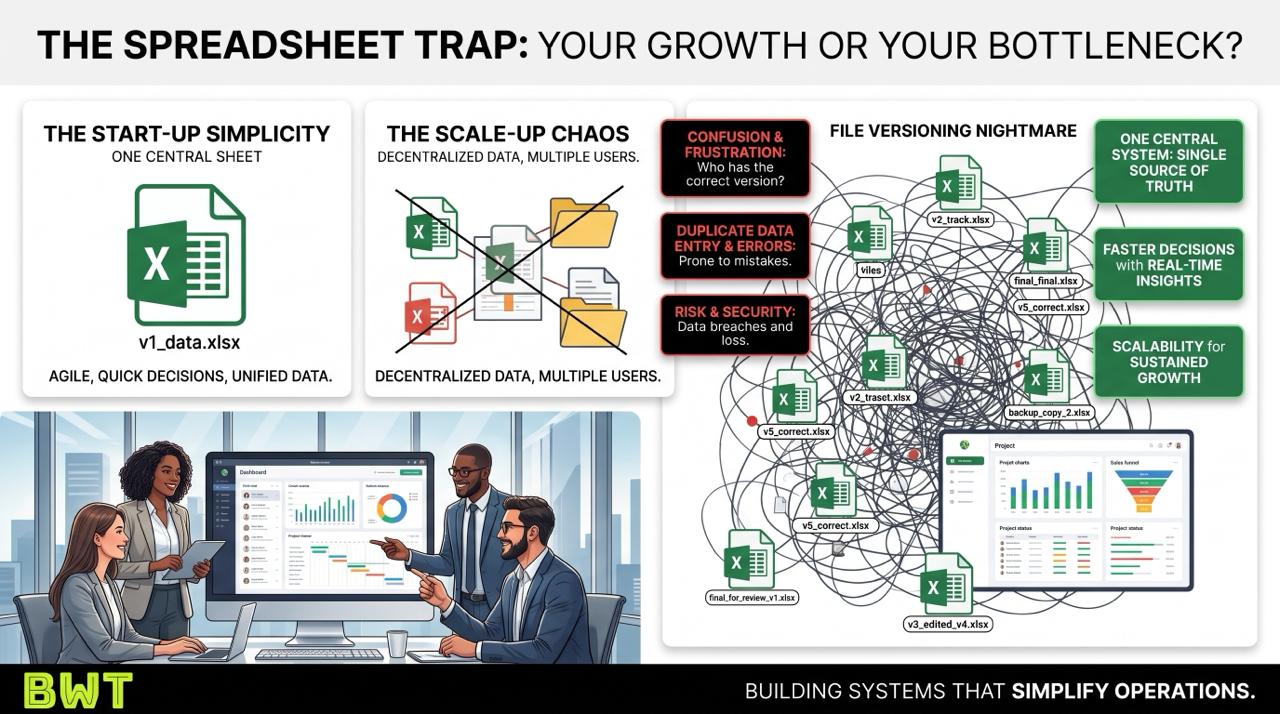
by Bhavya Web Technologies
Excel is one of the greatest business tools ever created.
Millions of businesses rely on it every day—for calculations, reporting, budgeting, forecasting, and analysis.
We use it too.
But there comes a point where spreadsheets quietly stop helping your business grow.
Instead, they become the bottleneck.
It Usually Starts with Simple Questions
As your business expands, your team starts asking:
If these questions sound familiar, the issue probably isn’t Excel.
It’s that your business has outgrown the way information is being managed.
Excel Works Brilliantly for Individuals
For one person—or even a small team—spreadsheets are incredibly efficient.
They allow you to:
Everything lives in one place.
Decisions happen quickly.
The business moves fast.
Growth Changes Everything
As more employees join the company, the workflow becomes more complex.
Suddenly you have:
The spreadsheet isn’t broken.
The process is.
Hidden Costs of Spreadsheet Dependency
Many businesses unknowingly lose valuable time because of spreadsheet management.
Common problems include:
These issues rarely appear in financial reports, but they affect productivity every single day.
The First Sign You Need a Business System
It’s not when Excel crashes.
It’s when your team spends more time searching for information than using it.
Think about how much time is spent each week:
That’s valuable time your team could spend serving customers or growing the business.
Imagine a Single Source of Truth
Instead of dozens of spreadsheets, imagine one centralized system where:
No duplicate files.
No version confusion.
No manual consolidation.
Just accurate information available whenever it’s needed.
Technology Should Simplify Work
Many businesses assume they need more employees when operations become difficult.
Sometimes they don’t.
Sometimes they need better systems.
Before hiring another person, ask:
“Are we solving a people problem—or a process problem?”
The answer can dramatically change how your business grows.
When Should You Move Beyond Excel?
You don’t need custom software simply because your business is growing.
But it may be time to consider one when:
These are often signs that your business has reached the next stage of growth.
Build Systems That Scale
A good business system doesn’t replace your team’s expertise.
It removes repetitive work.
It connects departments.
It improves visibility.
Most importantly, it gives your team more time to focus on customers instead of spreadsheets.
Final Thought
Excel isn’t the problem.
In fact, it’s one of the most valuable tools a business can use.
But every growing business eventually reaches a point where spreadsheets alone are no longer enough.
The goal isn’t to replace Excel.
The goal is to remove unnecessary friction, automate repetitive processes, and create systems that help your business scale with confidence.
Bhavya Web Technologies
Kukatpally, Hyderabad
We build business systems that simplify operations, improve productivity, and help growing companies scale—without unnecessary complexity.