
By Bhavya Web Technologies
Most business owners can tell you:
- How much they spend on advertising
- How many enquiries they receive
- How much they pay employees
- How much revenue they generated last month
But ask them:
“How long does it take your team to respond to a new lead?”
And many don’t know.
That’s a problem.
Because one of the biggest hidden costs in business isn’t a bad employee.
It’s a slow process.
And unlike salaries, rent, or advertising expenses, this cost rarely appears on a financial statement.
Yet it quietly destroys revenue every day.
What Happens After Someone Enquires?
Let’s look at a common scenario.
A potential customer visits your website.
They’re interested.
They fill out a contact form at 9:00 AM.
Now what?
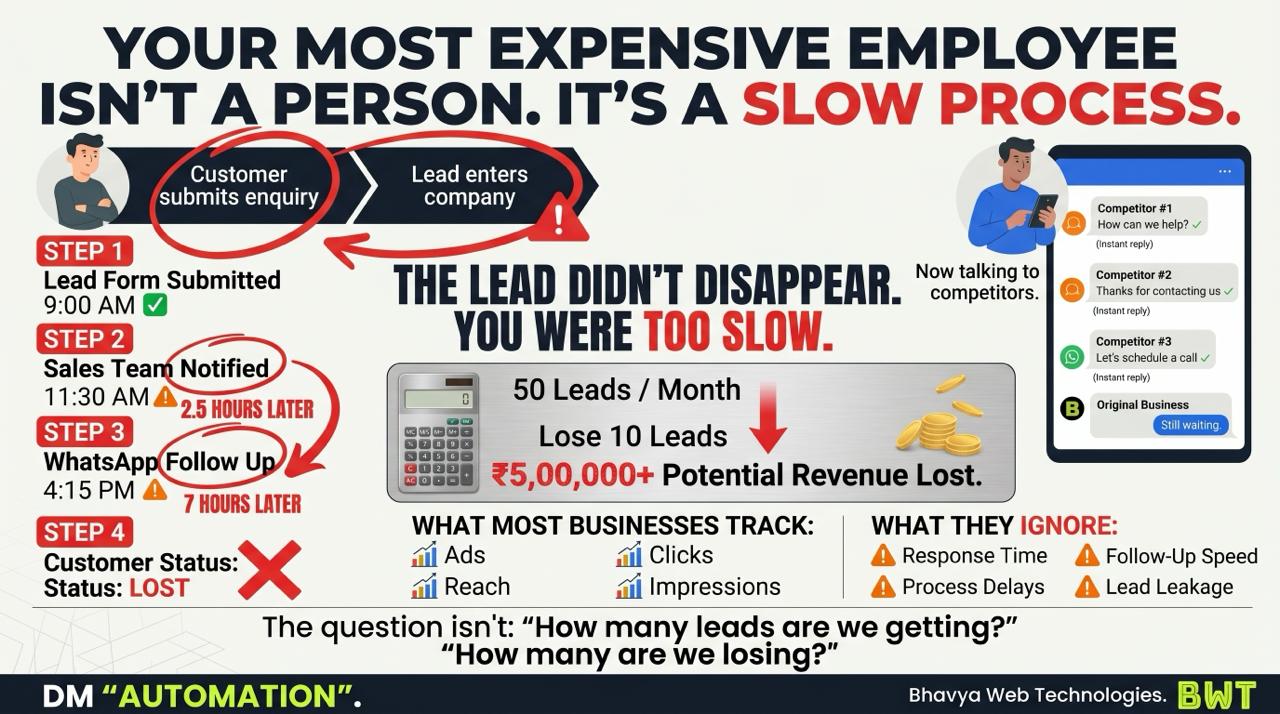
In many businesses, the process looks something like this:
Step 1
Customer submits an enquiry.
Step 2
Email notification arrives.
Nobody notices immediately.
Step 3
Sales team sees the enquiry later.
Step 4
Follow-up happens several hours later.
Step 5
Customer has already contacted competitors.
Step 6
Opportunity lost.
The lead didn’t disappear.
The business was simply too slow.
Modern Customers Don’t Wait
Customer behavior has changed dramatically.
Today, buyers expect speed.
When someone submits an enquiry, they often contact:
- multiple suppliers
- multiple agencies
- multiple service providers
at nearly the same time.
The first business to respond gains a huge advantage.
Not because they’re better.
Because they’re available.
In many industries, speed creates trust.
Slow responses create doubt.
The Hidden Revenue Leak
Most businesses track:
✅ Advertising spend
✅ Website traffic
✅ Click-through rates
✅ Leads generated
But they rarely track:
❌ Response time
❌ Follow-up delays
❌ Lead leakage
❌ Process bottlenecks
And that’s where significant revenue often disappears.
Imagine your business receives:
50 enquiries per month
Now assume you lose:
10 enquiries due to delayed follow-up
If the average customer value is ₹50,000, that’s:
₹5,00,000 in potential revenue lost
Not because of marketing.
Not because of competition.
Because of slow processes.
Why Slow Processes Feel Invisible
The danger is that nobody sees the loss.
A lead that never converts doesn’t show up on a report.
The customer doesn’t tell you:
“I chose your competitor because you replied six hours later.”
They simply move on.
Which makes slow processes difficult to detect.
But their impact compounds over time.
Businesses Obsess Over Lead Generation
Many companies spend months discussing:
- SEO strategies
- Google Ads
- Meta Ads
- content marketing
- lead generation campaigns
Yet ignore what happens after the lead arrives.
That’s like spending money filling a bucket while ignoring the holes in the bottom.
Generating leads matters.
Converting them matters more.
The Real Customer Journey
Most business owners imagine:
Lead → Sale
Reality is usually:
Lead → Response → Conversation → Trust → Proposal → Sale
If delays occur at any stage, conversion rates suffer.
That’s why operational efficiency has become a competitive advantage.
Where Most Businesses Lose Time
Delayed Notifications
Enquiries sit unnoticed in email inboxes.
Better Solution
Instant alerts via:
- CRM systems
- mobile notifications
- team communication platforms
Manual Lead Assignment
Staff manually distribute enquiries.
Better Solution
Automatically route leads to the correct team member.
Slow Follow-Ups
Sales teams respond hours later.
Better Solution
Immediate acknowledgement messages and rapid first contact.
Repetitive Tasks
Employees repeatedly perform the same administrative work.
Better Solution
Automate routine actions wherever possible.
Why Automation Matters
Automation isn’t about replacing people.
It’s about removing delays.
Examples include:
Instant Lead Notifications
The moment a form is submitted, the right person is notified.
Automatic WhatsApp Messages
Customers receive immediate confirmation that their enquiry was received.
CRM Integration
Leads automatically enter the sales pipeline.
Follow-Up Reminders
No enquiry gets forgotten.
These systems reduce response times dramatically.
Speed Creates Competitive Advantage
Imagine two businesses offering similar services.
Business A
Responds after six hours.
Business B
Responds within five minutes.
Who has the better chance of winning the customer?
Most of the time, it’s Business B.
Because speed signals professionalism.
And professionalism builds trust.
Questions Every Business Should Ask
Instead of asking:
“How many leads are we getting?”
Ask:
- How quickly do we respond?
- Where are delays occurring?
- How many enquiries go unanswered?
- How many leads never receive follow-up?
- How many opportunities are lost because of process inefficiencies?
These questions often reveal growth opportunities hiding in plain sight.
Conduct a Process Audit
Review your customer journey today.
Measure:
✅ Lead response time
✅ Follow-up speed
✅ Proposal turnaround time
✅ Sales process delays
✅ Customer communication gaps
Small improvements in these areas often produce larger gains than increasing marketing budgets.
Final Thought
Most businesses assume growth comes from generating more leads.
Sometimes it does.
But often the biggest opportunity is protecting the leads you already have.
Because the most expensive employee in many organizations isn’t a person.
It’s a slow process.
Every delay creates friction.
Every bottleneck costs opportunities.
Every missed follow-up reduces revenue.
The companies growing fastest aren’t always spending more on marketing.
They’re removing delays between customer interest and customer action.
And that’s where hidden growth usually lives.
Bhavya Web Technologies
Kukatpally, Hyderabad