
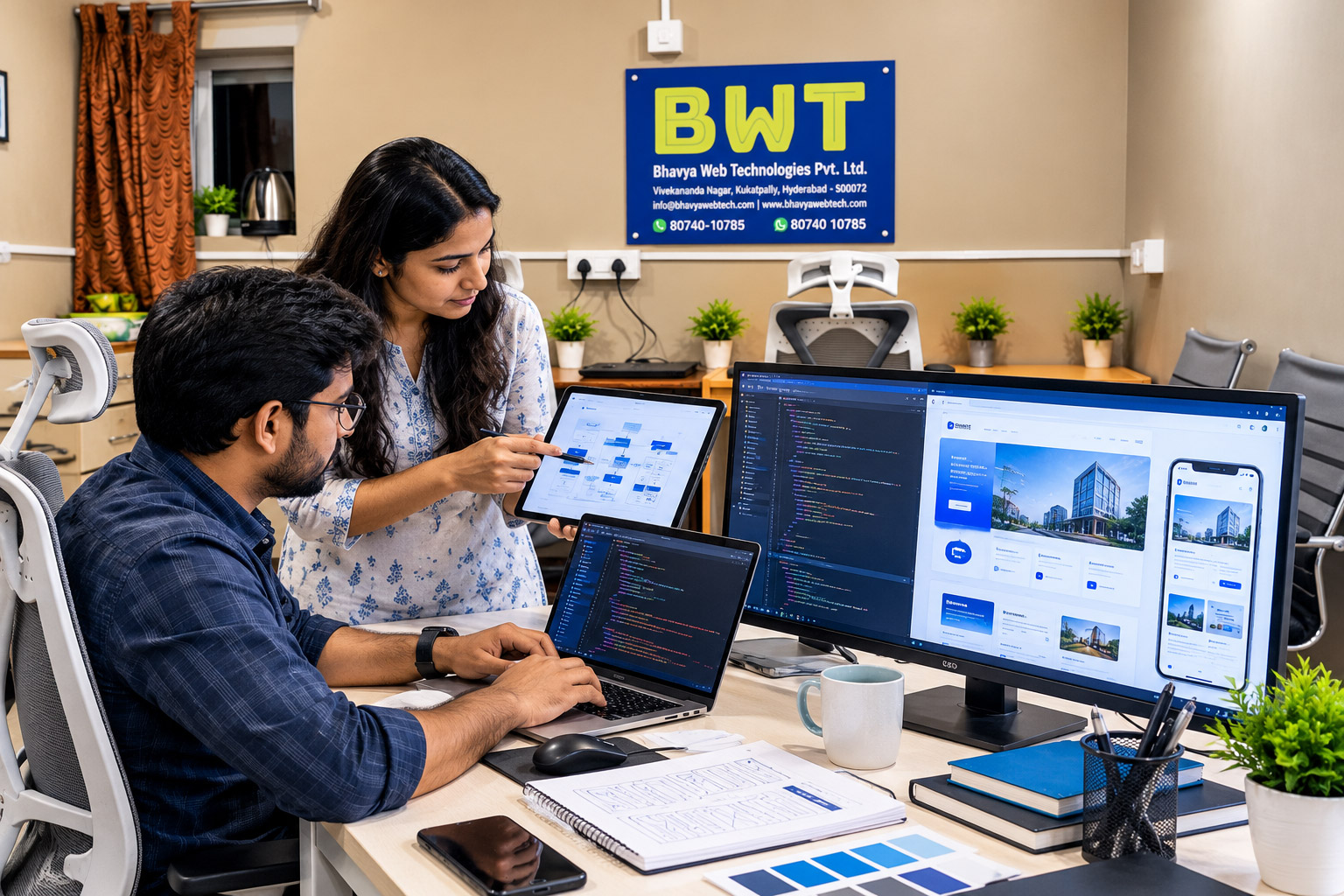
Businesses need more than an online presence to operate effectively in a digital-first environment. They need websites and web applications that communicate clearly, perform reliably, connect with essential business systems, and support future growth. Choosing a capable web development company in Hyderabad can help transform business requirements into practical digital solutions built around customer needs and operational objectives.
Bhavya Web Tech provides web and application development services for businesses seeking modern, functional, and scalable digital platforms. From corporate websites to custom web applications and eCommerce systems, successful development begins with understanding the problem, selecting appropriate technology, and establishing a clear implementation plan.
Why Web Development Matters for Business Growth
A business website can support sales, customer communication, lead generation, product discovery, and service delivery. Its effectiveness depends on how well the technology, content, design, and functionality work together.
A service-based company may need a website that explains its offerings and captures enquiries. An online retailer may require product catalogues, payment integration, inventory synchronisation, and order management. A growing organisation may need a custom application to automate internal workflows or provide customers with a secure online portal.
Each requirement calls for a different development approach. Defining the website’s purpose before choosing a platform helps businesses avoid unnecessary features and make better technical decisions.
Custom Web Development for Specific Requirements
Ready-made platforms can be effective for many projects, but some businesses need functionality tailored to their workflows. Custom web development makes it possible to build features around defined requirements rather than forcing every process into a fixed template.
Examples include customer dashboards, booking systems, reporting tools, membership platforms, internal management systems, and applications that connect multiple services.
A custom solution should begin with documented requirements, user journeys, data flows, and acceptance criteria. Developers can then design an architecture that addresses the current needs while allowing for planned improvements.
The goal is not to make every project complicated. It is to choose an approach that provides the required functionality, remains maintainable, and delivers practical value.
Modern Technologies for Web Development
Technology selection affects performance, flexibility, maintenance, and future development costs. The right stack depends on the application’s requirements, the team’s capabilities, and the systems that need to connect.
React and Next.js development
React supports component-based interface development, helping teams create reusable user interface elements. Next.js builds on React with additional capabilities for routing, rendering, and application development. These technologies can be suitable for content-rich websites, interactive platforms, and modern web applications.
Node.js and backend development
Backend systems manage business logic, data processing, authentication, and communication between services. Node.js can support server-side applications and APIs, depending on the project’s requirements.
WordPress and content management systems
WordPress can be appropriate for businesses that need to publish articles, update service pages, manage landing pages, and maintain content without changing code for every update. A carefully configured content management system can make everyday website management more accessible.
eCommerce platforms
Shopify, WooCommerce, Magento, and other commerce platforms support different selling models and operational needs. The choice depends on product complexity, integrations, catalogue size, checkout requirements, and future expansion.
Bhavya Web Tech works with modern web technologies and platform-based solutions to address different development requirements.
Responsive Design and User Experience
A web application should be practical to use across desktop computers, tablets, and smartphones. Responsive layouts, readable typography, clear navigation, and accessible controls help visitors complete tasks with less friction.
Development should account for real user journeys rather than focusing only on the homepage. Important interactions might include filling out a contact form, searching a catalogue, creating an account, booking an appointment, or completing a purchase.
Wireframes and prototypes help teams evaluate page structure and functionality before implementation. Testing on different screen sizes and browsers can reveal layout problems, confusing interactions, and accessibility issues early.
Explore our UI/UX design services to understand how user research, interface planning, and experience design can support a more usable digital product.
Website Performance and Technical Quality
Website speed and reliability influence how people experience a digital service. Slow pages, broken forms, inconsistent layouts, and failed transactions can frustrate visitors and interrupt business activities.
Performance optimisation may involve image compression, efficient code, caching, database improvements, and reducing unnecessary scripts. Developers should also assess server response, page rendering, layout stability, and the responsiveness of interactive elements.
Technical quality includes working navigation, appropriate error handling, secure connections, form validation, browser compatibility, and reliable integrations. Testing should cover both expected user journeys and failure scenarios, including interrupted connections and invalid inputs.
Measure performance with appropriate tools and investigate the causes of problems before applying changes. Optimisation should improve the actual user experience without breaking essential functionality.
Secure and Scalable Web Applications
Security should be considered throughout development. Depending on the application, important controls may include secure authentication, role-based permissions, input validation, protected API endpoints, encrypted data transmission, and timely dependency updates.
Businesses that collect personal or financial information should also establish appropriate data-handling practices and review relevant legal obligations. Access to sensitive information should be limited to authorised users, and critical operations should be tested carefully.
Scalability requires an architecture suited to expected usage and future requirements. This may involve suitable database design, efficient API communication, caching, monitoring, and cloud infrastructure. Not every project needs a complex distributed system from day one. A maintainable foundation with a clear path for expansion is often the more practical choice.
API Integrations and Business Automation
Web applications frequently need to communicate with other systems. Examples include payment gateways, customer relationship management platforms, inventory software, shipping services, analytics tools, and third-party business APIs.
Before implementation, identify what information must be exchanged, which system owns each data field, and how errors should be handled. Confirm API permissions, authentication methods, rate limits, and vendor dependencies.
Reliable integrations should account for timeouts, duplicate requests, failed transactions, and changing third-party requirements. Testing these scenarios helps prevent inconsistent records and unnecessary manual work.
Explore our custom web application development solutions for projects that require tailored workflows, specialised functionality, or connections between business systems.
eCommerce and Online Business Platforms
An eCommerce website needs to support the entire purchasing journey, from product discovery to checkout and order fulfilment. Product information, category navigation, search, filtering, payment options, delivery information, and customer notifications should work together smoothly.
Businesses should also consider inventory management, tax configuration, shipping rules, returns, reporting, and integration with existing operations. A technically functional store may still create problems if the checkout process is confusing or essential product information is missing.
Platform selection should reflect the business model, expected catalogue complexity, administration requirements, and planned integrations.
Bhavya Web Tech provides eCommerce development solutions for businesses planning online stores and digital commerce experiences.
The Web Development Process
A structured process helps stakeholders understand what is being built, why decisions are being made, and how progress will be evaluated.
1. Discovery and requirements: Define business goals, users, features, integrations, and project constraints.
2. Technical planning: Select the architecture, platform, data model, and deployment approach.
3. Design and prototyping: Map user journeys and review interface layouts before full implementation.
4. Development: Build frontend interfaces, backend services, and required integrations.
5. Testing and quality assurance: Validate functionality, responsiveness, security, compatibility, and performance.
6. Deployment: Configure production services, release the application, and verify essential workflows.
7. Maintenance and improvement: Monitor performance, address defects, update dependencies, and plan enhancements.
Set clear milestones, responsibilities, approval processes, and acceptance criteria before development starts. Regular reviews can help identify issues early and keep the project aligned with its intended outcomes.
How to Choose a Web Development Company in Hyderabad
Selecting a development partner requires evaluating more than technical terminology or a visual portfolio. Look for a team that understands your business requirements, explains its recommendations, and can describe how quality will be tested.
Ask about relevant project experience, technology choices, source code ownership, documentation, security practices, deployment procedures, and post-launch support. Confirm how project changes are estimated and how progress will be communicated.
Request a clear scope covering deliverables, dependencies, exclusions, integrations, and maintenance responsibilities. This helps you understand what is included and reduces ambiguity during delivery.
A suitable partner should be able to explain trade-offs honestly. Technology should serve the business objective rather than add complexity without a clear benefit.
Ongoing Maintenance and Technical Support
Launching a website is not the end of its lifecycle. Frameworks, plugins, APIs, hosting environments, and browser behaviour can change over time. Without maintenance, an application may become vulnerable, unreliable, or difficult to update.
A maintenance plan may include security patches, backups, uptime monitoring, bug fixes, performance reviews, compatibility checks, and content updates. The appropriate level of support depends on the importance and complexity of the website.
Bhavya Web Tech provides website maintenance and support to help businesses maintain their digital platforms and address ongoing technical requirements.
Conclusion
Choosing a web development company in Hyderabad is an important step towards building a digital platform that supports your business objectives. Clear requirements, appropriate technology, thoughtful user experience, secure engineering, reliable testing, and ongoing maintenance all contribute to a successful outcome.
Whether you need a corporate website, an eCommerce store, or a custom web application, start by identifying the problem the solution should address and the results you need to measure.
Bhavya Web Tech helps businesses plan and build digital solutions around their technical and operational needs.
Ready to discuss your project? Visit Bhavya Web Tech to explore our services and start a conversation about your web development requirements.