
By Bhavya Web Technologies
One of the quickest ways to lose a potential customer is surprisingly simple:
Make them ask for the price.
Many business owners believe hiding prices will encourage enquiries. The logic sounds reasonable:
- “If competitors see our pricing, they’ll undercut us.”
- “Every project is different, so we can’t list a price.”
- “If we show prices, customers will compare us.”
But here’s the reality:
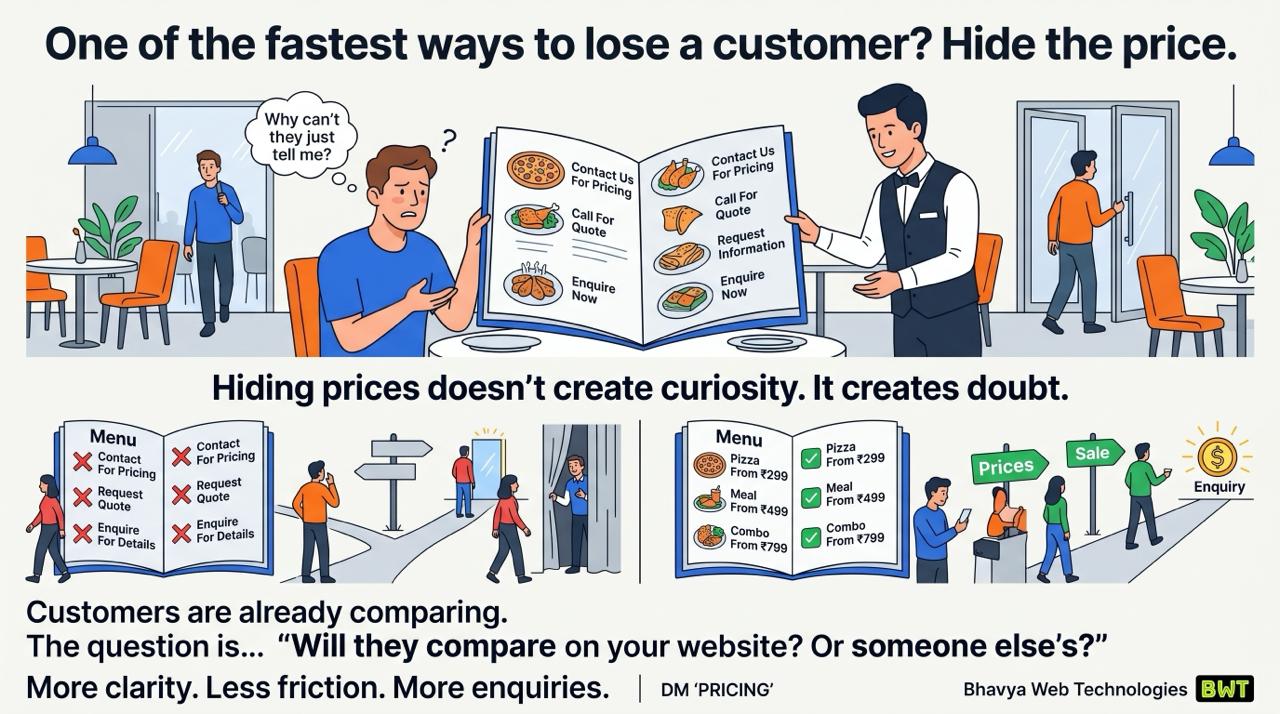
Customers are already comparing.
The only question is whether they compare while staying on your website—or after leaving it for a competitor’s.
The Modern Buyer Wants Transparency
Before contacting a business, most customers want to know one thing:
“Can I afford this?”
If your website provides no pricing guidance, visitors are forced to guess.
Some assume you’re too expensive and leave.
Others think you’re too cheap.
Many simply move on to another website that provides clearer information.
Lack of pricing doesn’t create curiosity.
It often creates uncertainty.
Imagine This in the Real World
Picture yourself walking into a restaurant.
You sit down, open the menu, and instead of prices you see:
- “Contact us for pricing”
- “Request a quote”
- “Enquire for meal cost”
Most people would feel frustrated.
You’d probably choose another restaurant with a transparent menu.
The same psychology applies online.
Visitors appreciate businesses that help them make informed decisions.
Why Businesses Avoid Displaying Prices
There are valid reasons not to publish exact pricing.
For example:
- Every project is customized.
- Costs depend on scope and complexity.
- Final pricing requires consultation.
- Packages vary by client requirements.
But hiding all pricing information can create unnecessary friction.
A better approach is to provide context.
Give Customers a Starting Point
Instead of publishing exact quotes, consider sharing ranges or starting prices.
Examples:
- Business Websites – Starting from ₹25,000
- E-commerce Stores – Starting from ₹45,000
- Custom Software Projects – From ₹1,00,000+
- SEO Packages – Starting at ₹15,000 per month
This immediately helps visitors understand whether your services align with their budget.
It also filters out poor-fit enquiries, saving time for both sides.
Pricing Helps Build Trust
Transparency is a trust signal.
When businesses openly communicate pricing expectations, customers often perceive them as more confident and honest.
Clear pricing also reduces common questions like:
- “Will this be within my budget?”
- “Am I wasting my time contacting them?”
- “Are there hidden costs?”
The easier you make it for visitors to evaluate your services, the more likely they are to engage.
Customers Compare Anyway
Some business owners worry that competitors will see their pricing.
They will.
But customers are comparing far more than prices.
They’re also comparing:
- quality
- expertise
- turnaround time
- reviews
- communication
- trustworthiness
- overall value
Being transparent doesn’t automatically make you lose on price.
In many cases, it helps you compete on clarity and confidence.
When You Shouldn’t List Exact Prices
There are situations where publishing a fixed price isn’t practical.
For example:
- enterprise software
- large construction projects
- highly customized consulting
- bespoke manufacturing
- complex digital transformation projects
In these cases, you can still provide useful guidance:
- “Projects typically range from ₹2 lakh to ₹10 lakh depending on requirements.”
- “Most clients invest between ₹50,000 and ₹1.5 lakh.”
- “Custom quotations are provided after a discovery call.”
This gives prospects a realistic expectation without locking you into a single figure.
Replace “Contact for Pricing” With Helpful Information
Instead of saying:
❌ “Contact us for pricing.”
Try:
✅ “Website packages start from ₹25,000.”
❌ “Request a quote.”
Try:
✅ “Most projects range between ₹40,000 and ₹80,000 depending on features.”
❌ “Pricing available on enquiry.”
Try:
✅ “Book a free consultation to receive a customized estimate based on your requirements.”
These alternatives reduce uncertainty while still encouraging conversation.
Pricing Is Part of the Buying Experience
People don’t want surprises.
They want confidence.
Providing pricing guidance helps visitors answer three critical questions:
- Can I afford this?
- Is this business within my expected budget?
- Is it worth reaching out?
When those questions are answered early, enquiries become more qualified and conversions often improve.
Final Thought
You don’t have to publish a detailed price list for every service.
But giving customers some pricing context can dramatically improve their experience.
Remember:
- Hidden pricing creates hesitation.
- Transparent pricing builds confidence.
- Clear expectations reduce friction.
- Less friction leads to more enquiries.
In today’s competitive digital landscape, the businesses that make buying easier often win more customers.
So before removing pricing from your website, ask yourself:
Are you protecting your business—or accidentally pushing potential customers toward a competitor who is simply more transparent?
Bhavya Web Technologies
Kukatpally, Hyderabad