
By Bhavya Web Technologies
Every business owner has experienced it.
A potential customer shows interest.
They visit your website.
They ask a few questions.
Then they disappear.
A few days later, you discover they chose a competitor.
The natural reaction is:
“They were cheaper.”
“They have a bigger team.”
“They offer better services.”
But often, none of those things are true.
In many cases, your competitor didn’t win because they were better.
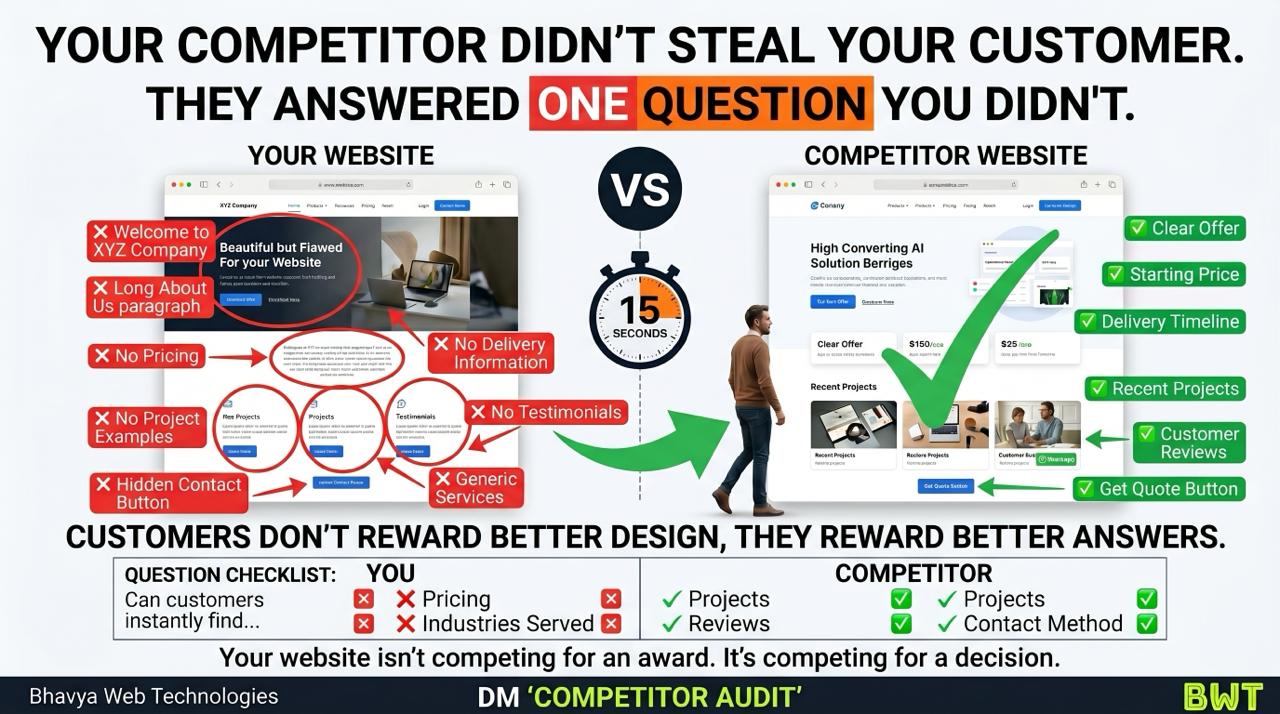
They won because they answered one question your website didn’t.
The Real Competition Isn’t Design
Most businesses evaluate websites the wrong way.
They compare:
- Colors
- Layouts
- Animations
- Fonts
- Visual effects
Customers don’t.
Customers compare answers.
When someone lands on your website, they’re not judging it like a designer.
They’re asking:
- Can this company solve my problem?
- How much might it cost?
- How long will it take?
- Have they done this before?
- Can I trust them?
- How do I contact them?
The website that answers those questions fastest usually wins.
The 15-Second Decision Window
Modern customers don’t read websites.
They scan them.
Within seconds, visitors are deciding:
- Stay or leave
- Trust or doubt
- Contact or ignore
That means your website has a very short window to communicate value.
If visitors can’t find the information they need quickly, they move on.
And often, they move directly to a competitor.
The Website Comparison Exercise
Open your website.
Now open your biggest competitor’s website.
Ignore the design.
Ignore the colors.
Ignore the branding.
Focus only on the questions customers are trying to answer.
Can visitors instantly find:
Pricing Information
Not necessarily exact pricing.
But enough context to understand whether you’re within their budget.
Examples:
- Starting prices
- Package options
- Pricing approach
- Project ranges
Delivery Timelines
Customers want to know:
- How long will this take?
- When can I expect results?
- What is the typical turnaround?
Businesses that provide timelines reduce uncertainty.
Industries Served
Visitors often look for relevance.
They want to know:
- Have you worked with companies like mine?
- Do you understand my industry?
- Are you experienced in my market?
The easier you answer these questions, the easier trust becomes.
Recent Projects
Proof matters.
Customers trust evidence more than promises.
Showing recent work helps visitors visualize what working with your company might look like.
Reviews and Testimonials
People trust other customers.
Reviews provide reassurance that your company delivers results.
They reduce perceived risk.
Contact Methods
Can someone contact your business immediately?
Or must they:
- search for a contact page
- complete a long form
- navigate multiple pages
The easier it is to contact you, the more enquiries you’ll receive.
Customers Reward Clarity
One of the most common discoveries during website audits is this:
The better-looking website rarely wins.
The clearer website usually does.
A website with:
- straightforward messaging
- visible pricing guidance
- real project examples
- customer testimonials
- simple contact options
often outperforms a visually impressive website filled with vague marketing language.
Because customers don’t reward creativity.
They reward clarity.
Why Questions Matter More Than Features
Business owners love talking about features.
Customers care about outcomes.
A customer isn’t thinking:
“What technology do they use?”
They’re thinking:
“Can they solve my problem?”
Every unanswered question creates friction.
Every answered question creates confidence.
And confidence leads to enquiries.
The Hidden Cost of Missing Information
When visitors can’t find information on your website, they don’t always contact you.
Many simply leave.
That’s what makes missing information so expensive.
You never see the lost opportunity.
You only see fewer enquiries.
And often, those enquiries go to a competitor who made answers easier to find.
Your Website Is Competing for a Decision
Many businesses treat websites like branding projects.
But your website isn’t competing for an award.
It’s competing for a decision.
The visitor is deciding:
- Whether to trust you
- Whether to contact you
- Whether to buy from you
Everything on your website should support that decision.
Conduct a Customer Audit
This week, spend 15 minutes reviewing your website from a customer’s perspective.
Ask:
Can I quickly find:
✓ Pricing information?
✓ Delivery expectations?
✓ Industries served?
✓ Project examples?
✓ Reviews?
✓ Contact options?
If the answer is no, you’ve found opportunities for improvement.
And those opportunities are often worth more than a complete redesign.
Final Thought
Your competitor probably didn’t steal your customer.
They simply removed more uncertainty.
They answered more questions.
They reduced more friction.
And they made it easier for a customer to feel confident.
The businesses winning online today aren’t always the most creative.
They’re often the clearest.
Because websites don’t win customers by looking impressive.
They win customers by helping people make decisions.
And the fastest way to influence a decision is to answer the questions customers are already asking.
Bhavya Web Technologies
Kukatpally, Hyderabad